A Rocky Year: Governance Drama and Market Turbulence
The past twelve months have been brutal for 48 Club Token holders. Back in June 2025, the project dropped a bombshell—a risk warning revealing that KOGE had no lockup period and that the DAO never actually promised to limit treasury sales. The market’s reaction was swift and merciless: prices cratered by 63–64% in less than an hour. Trust, once lost, is hard to rebuild, and that announcement did serious damage.
Then came the flash crash. Large wallets dumped their holdings while liquidity evaporated in coordinated fashion. KOGE wasn’t alone—ZKJ took a similar beating, largely because both tokens shared overlapping liquidity pools and were vulnerable to the same risky incentive structures around Binance Alpha Points farming. When one fell, the other followed.
But it hasn’t been all bad news. The team has been working to regain credibility through active DAO governance. Recent proposals have focused on smarter capital allocation and ramping up buyback activity. In Q2 2025, the treasury accumulated over 200,000 KOGE, and the project has been adapting its ecosystem—phasing out features that no longer fit with the BNB Chain and signaling they’re still committed to long-term survival.
Where KOGE Stands Right Now
At the moment, KOGE is trading around $47.97, barely moving over the last 24 hours. The narrow range between $47.89 and $48.14 suggests the market is in wait-and-see mode—low volatility, low conviction. The circulating supply is fully out there: roughly 3.388 million KOGE, with no more tokens waiting in the wings.
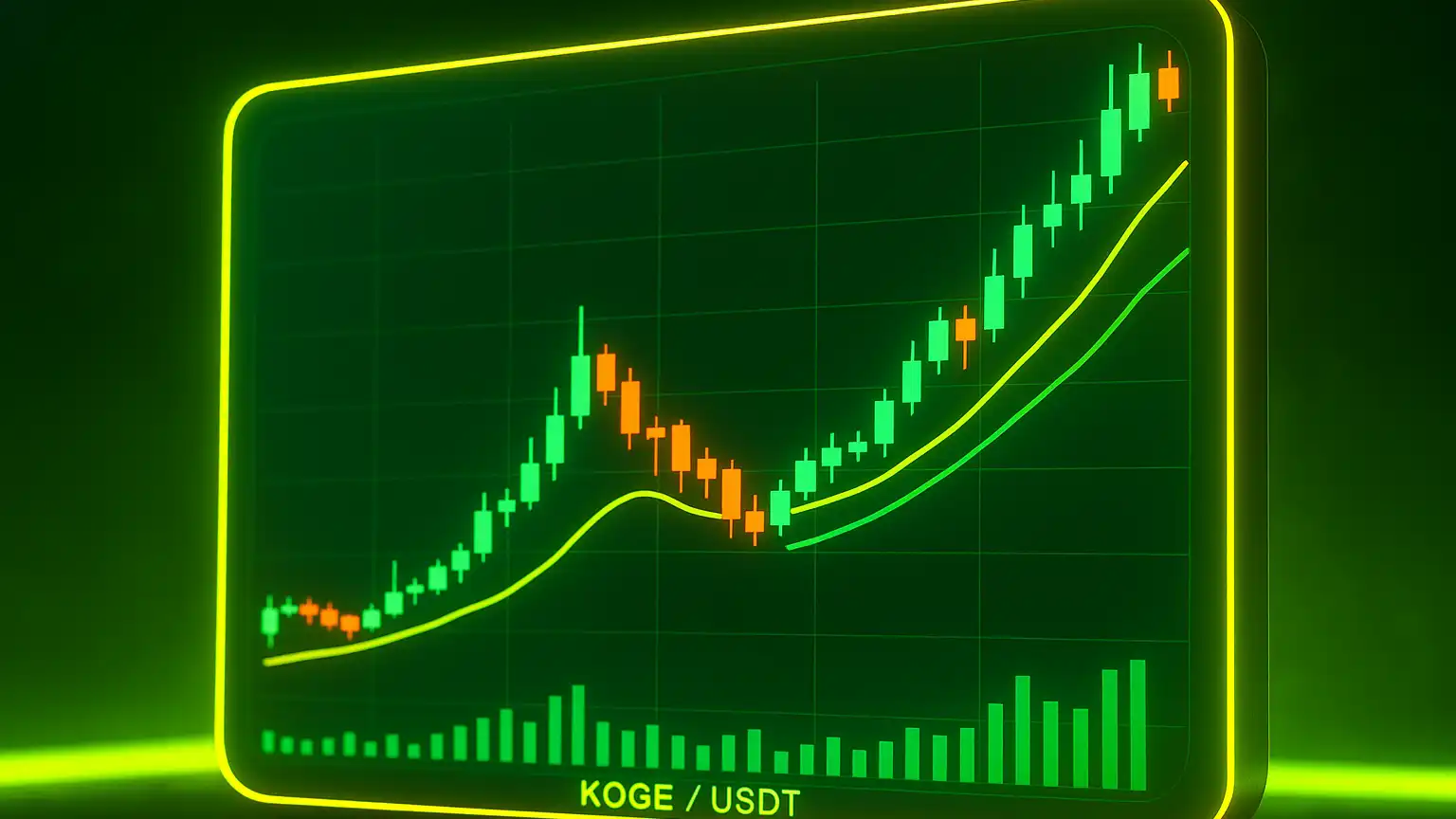
From a technical standpoint, the picture is mixed. The Relative Strength Index (RSI) is probably sitting in neutral-to-slightly-oversold territory, meaning there’s not much bullish energy but no signs of complete exhaustion either. Short-term moving averages—the 20-day and 50-day—are likely acting as resistance, keeping a lid on any upward movement. The 200-day moving average is probably well above current prices, which points to a longer-term bearish trend unless something big changes.
The MACD indicator has shown brief moments of bullish crossover in recent weeks, but those haven’t stuck. Each time momentum started building, it fizzled out—usually thanks to more liquidity exits or uncertainty around treasury behavior. The MACD line is likely hovering near its signal line now, suggesting consolidation rather than a clear move in either direction. Volume has been lackluster, which isn’t surprising given the trust issues still hanging over the project.
What Comes Next: Two Possible Paths
If things go south: KOGE could retest support around $35–$40 if it can’t break above those short-term moving averages. That zone represents the psychological floor where buyers have shown up in the past. But if trust continues to erode and sellers get aggressive, we could see a drop back to $25 or even lower. Without a clear commitment from the DAO to stop surprise treasury dumps, the downside risk is real.
If the winds shift: A strong catalyst could change everything. Imagine the DAO publicly commits to strict limits on large sales, or a new utility feature launches on BNB Chain that reignites interest. If buyers come back in and KOGE closes above the 20-day and 50-day exponential moving averages, we’d be looking at resistance levels around $60–$70. The all-time high near $66.90 would be the next big test. Push past that with solid volume and improved governance transparency, and $80+ becomes possible.
Key Levels to Keep an Eye On
Support: Watch $35–40 closely. That’s where buyers have stepped in before. If that breaks, $25 is the next floor.
Resistance: The $50–65 zone aligns with short-to-mid-term moving averages and represents the first real hurdle. Above that, the all-time high at $66.90 is the major barrier to any serious rally.
Momentum signals: A positive MACD crossover combined with RSI climbing above 55–60 would suggest the bulls are waking up. On the flip side, if RSI dips toward 30 and MACD turns negative, it’s a warning sign to brace for more downside.
The Trust Problem
For anyone thinking about investing in KOGE, the central question isn’t really about chart patterns or support zones. It’s about whether the DAO can prove it won’t keep dumping tokens on the market without warning. Until there’s visible, enforceable restraint on treasury behavior, any positive technical setup could be wiped out by another surprise sell-off.
Beyond that, liquidity matters. KOGE needs strong, stable liquidity on major exchanges and less dependence on speculative incentive games that can blow up overnight. Plenty of projects with similar tokenomics have stagnated because the market simply stopped believing in them. Rebuilding that belief will take time, transparency, and consistent follow-through from the team.