Market Context and Recent Developments
The aelf project has been quietly building out its infrastructure, regularly allocating ELF tokens to eBridge—its cross-chain protocol designed to link aelf with Ethereum and other networks. On paper, this kind of interoperability work is positive. Cross-chain bridges tend to attract developers and users who want to move assets around without friction. Over time, that can translate into stronger fundamentals.
But the other side of the story is much less encouraging. aelf has faced a string of exchange delistings, the most significant being KuCoin’s removal of the token on January 30, 2026. When exchanges drop a coin, it’s not just symbolic—liquidity dries up, trading volume drops, and casual investors lose easy access. For a mid-tier project like aelf, that’s a serious headwind. The result is a market caught between long-term technical promise and short-term sentiment trouble.
Technical Indicators and Price Behavior
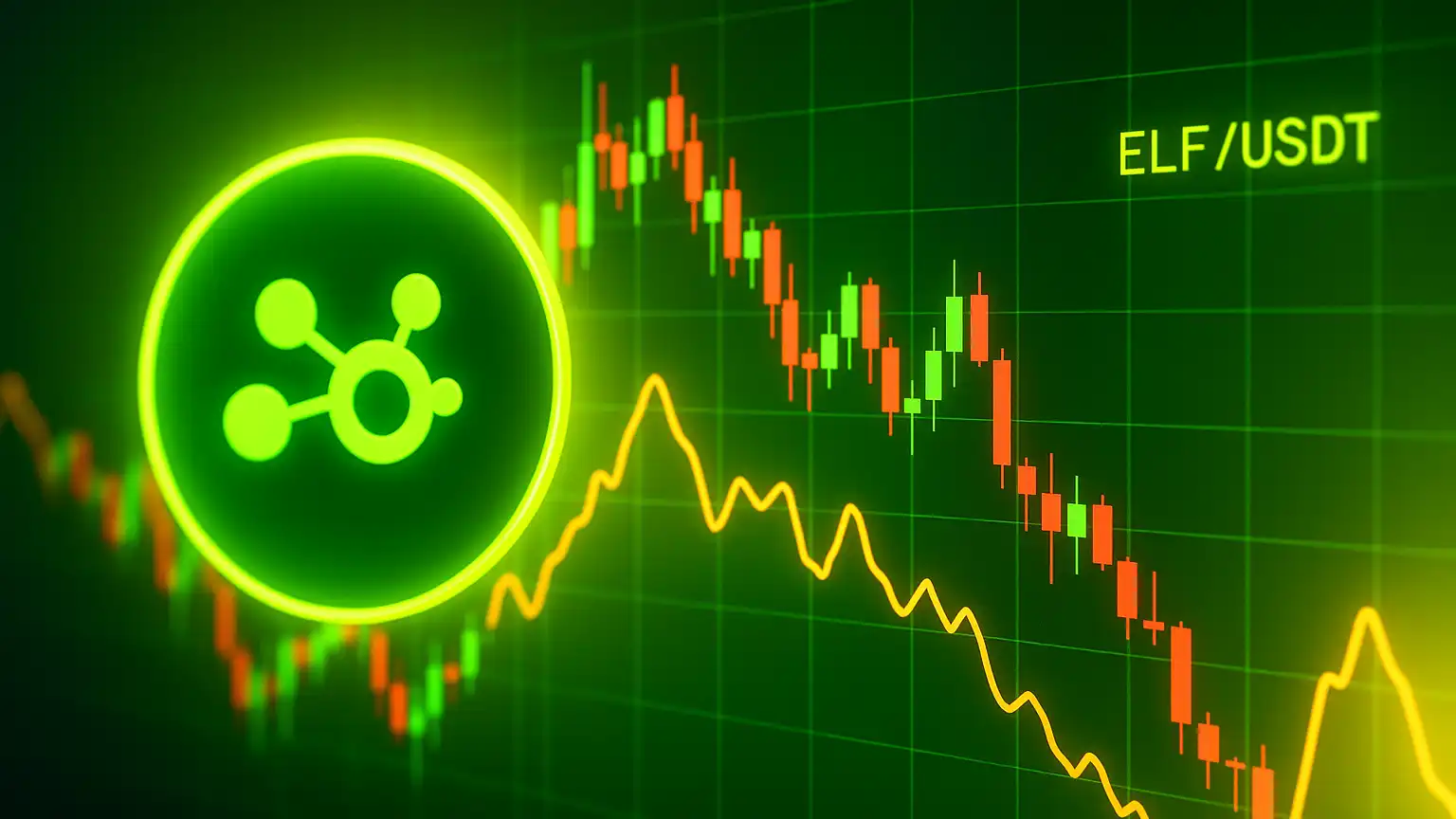
On the 4-hour chart, ELF/USDT is trading around $0.08197—well below recent moving averages. The Relative Strength Index hovers in the mid-40s, which is neutral territory. It’s not oversold, but it’s not showing any buying momentum either. The MACD sits just below its signal line, printing a slightly negative histogram. That’s not a strong sell signal, but it does suggest the market is drifting with a bearish tilt.
The 4-hour Simple Moving Average is near $0.2207, and the Exponential Moving Average is around $0.2179. Both are far above the current price, confirming that ELF is deep in a downtrend on shorter timeframes. Daily pivot analysis puts resistance zones between $0.2199 and $0.2355, while support stretches from $0.2043 down to $0.1887. Given where the price sits now, even the first resistance level looks ambitious without a major shift in sentiment.
Key Levels to Watch
If selling picks up, the next meaningful support sits around $0.0800. A break below that could push ELF toward $0.0700 or lower, depending on how much volume comes in. On the upside, reclaiming the $0.120 to $0.125 range would be the first step toward a trend reversal. From there, the coin would need to push past $0.21 and $0.22 to really change the narrative—but that’s a tall order given current technicals.
Outlook and What Comes Next
The three- to six-month picture for ELF is cautious at best. The halving event in December 2024 cut block rewards in half, which should theoretically reduce supply and support price. But supply-side changes only matter if demand keeps up, and right now, demand is soft. Delisting from major exchanges has made it harder for new buyers to get in and for existing holders to exit cleanly. That creates a liquidity trap that weighs on price discovery.
Still, aelf’s positioning as an AI-focused Layer-1 blockchain with cross-chain capabilities gives it a compelling story—if the ecosystem can deliver. A surge in dApp adoption, a spike in eBridge transaction volume, or a surprise relisting on a top-tier exchange could change the momentum quickly. In that scenario, ELF might test the $0.15 to $0.20 range over the next few months.
Without those catalysts, though, the more likely path is continued sideways action or a gradual slide. If broader market conditions stay weak and sector-wide capital flows don’t improve, ELF could retest the $0.05 to $0.07 zone by mid-2026.
Factors Worth Monitoring
Keep an eye on exchange and institutional moves. A relisting announcement or regulatory clarity around aelf’s operations could flip sentiment overnight. Volume spikes tied to eBridge activity—especially large cross-chain transfers—could also signal early bullish momentum.
Macro factors matter too. Interest rates, crypto regulation, and competition from other AI-focused blockchains will all play a role. Given aelf’s size and liquidity challenges, it’s especially sensitive to shifts in risk appetite. If the broader crypto market catches a bid, speculative tokens like ELF tend to benefit disproportionately—for better or worse.