Recent News and Ecosystem Catalysts
Celo has been making waves lately with some pretty interesting developments that traders should keep an eye on. The biggest headline? A proposed buyback-and-burn mechanism that could fundamentally change how CELO accrues value. If this upgrade goes through, more than half of the protocol’s profits — whatever’s left after covering operating costs — would go toward buying CELO tokens from the open market, with a portion of those purchases getting permanently burned. It’s the kind of deflationary pressure that could genuinely support price over time, assuming the proposal gets formally adopted and implemented.
There’s also some real traction happening on the ground in emerging markets. Opera’s MiniPay wallet, which runs on Celo’s infrastructure, has integrated both USDT and a gold-backed stablecoin. We’re talking about more than 11 million activated wallets and over 300 million transactions since launch. That’s not just vanity metrics — actual usage is growing, which means more on-chain volume and network fees. And those are the fundamental drivers that create organic demand for CELO tokens.
4-Hour Technical Indicators and Key Price Levels
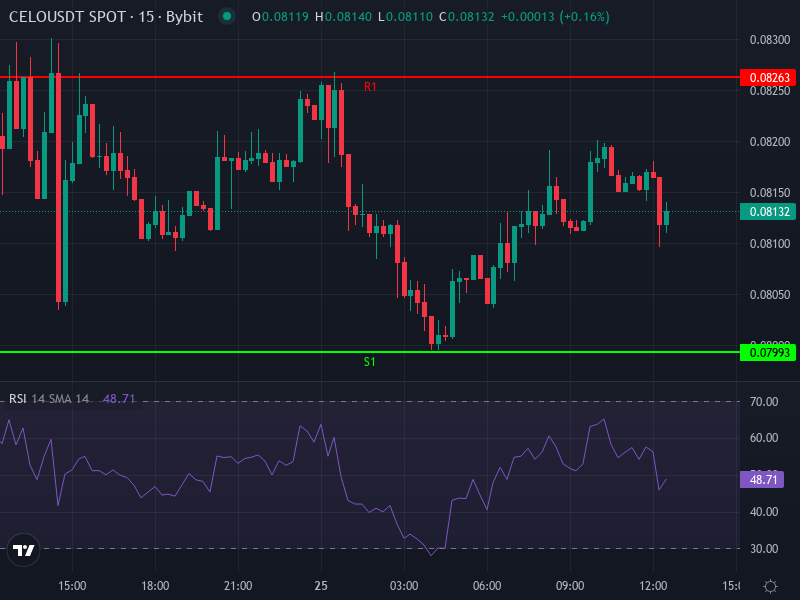
Right now, CELO/USDT is trading around $0.08125, down roughly 0.93% in the last 24 hours. Looking at the 4-hour chart, the exponential moving average sits at about $0.08099 — just below current price — which means it’s acting as immediate support if we see a pullback. The simple moving average is a touch higher at $0.08142, creating a soft resistance ceiling right above where we’re trading now.
The RSI is hovering around 51.1 on this timeframe, which is pretty much neutral territory. We’re not overbought, we’re not oversold — basically, buyers and sellers are in a standoff. The MACD just crossed above its signal line with a small positive histogram reading of about 0.000086, suggesting there’s a hint of upward momentum building. But let’s be honest, it’s weak. The price is stuck close to those moving averages, which usually means we’re range-bound until something changes — either volume picks up or we get a catalyst.
Pivot Levels and Scenario Analysis
Using daily pivot points, the main pivot sits right around $0.08127 — essentially where we are now. Resistance levels stack up at R1 around $0.08263, R2 near $0.08397, and R3 up at $0.08533. On the downside, support zones are marked at S1 roughly $0.07993, S2 around $0.07857, and S3 down near $0.07723. These levels basically frame the battlefield for the near term. A break in either direction should give us a clearer sense of where momentum is headed.
Given what we’re seeing, here’s how things could play out. On the bullish side, if demand picks up and that MACD momentum continues building, CELO could push toward R1 at $0.0826. If it manages to hold above that and buyers stay engaged, we could see a test of R2 around $0.0840, maybe even R3 near $0.0853 — especially if the buyback-and-burn proposal gets ratified or MiniPay activity keeps surging.
On the flip side, if the current support zone around $0.0799-$0.0800 fails to hold, we could see a drop toward S2 near $0.0786. And if that breaks too, S3 around $0.0772 becomes the next logical target, which would mean we’re in for further downside. The neutral RSI gives room for movement either way, so this could honestly swing in any direction depending on volume and sentiment over the next few sessions.
Long-Term Implications and Tokenomics Pressure
Looking beyond the short-term charts, the proposed deflationary mechanism could be a game-changer for CELO’s long-term value proposition. If on-chain usage and revenue keep climbing, scarcity becomes a real factor. And it’s not just speculation — Celo is already one of the top chains for hosting tokenized real-world assets. More RWAs mean more fee income, which could justify significantly higher valuations down the road.
There’s also Opera’s commitment to consider. They’re planning to stake 160 million CELO tokens, which signals a transition from being just a partner to a serious, long-term stakeholder in the ecosystem. That kind of alignment between builders and token holders matters. If those tokens get locked or staked, it reduces circulating supply and eases selling pressure. Combined with the buyback-and-burn, you’ve got multiple vectors converging toward tighter supply dynamics — and that’s the kind of setup that can support sustained price appreciation if demand holds up.