
Why Creditcoin Matters Right Now
Creditcoin isn’t just another DeFi token—it’s quietly building something more interesting. The project recently teamed up with Midnight Foundation to create a privacy-focused digital identity system that can tell humans apart from bots without exposing your financial data. Think of it as a way to build credit history on-chain while keeping your business your own. That’s a big deal as regulators start paying closer attention to who’s actually behind crypto transactions.
Under the hood, Creditcoin runs a dual-chain setup: one layer built on Substrate that’s optimized for recording credit and real-world asset data, and another EVM-compatible layer for smart contracts. This architecture makes it cheap to record credit transactions while staying compatible with the broader Ethereum ecosystem. It’s designed for things like tokenized real estate, peer-to-peer lending, and building financial reputations across borders.
The CTC token itself gets used for staking, paying transaction fees, and voting on network decisions. As more lending platforms and credit apps plug into Creditcoin, the token could see more genuine use beyond just speculation. That utility is starting to matter as the space matures and people look for projects with actual adoption, not just hype.
Reading the Price Action
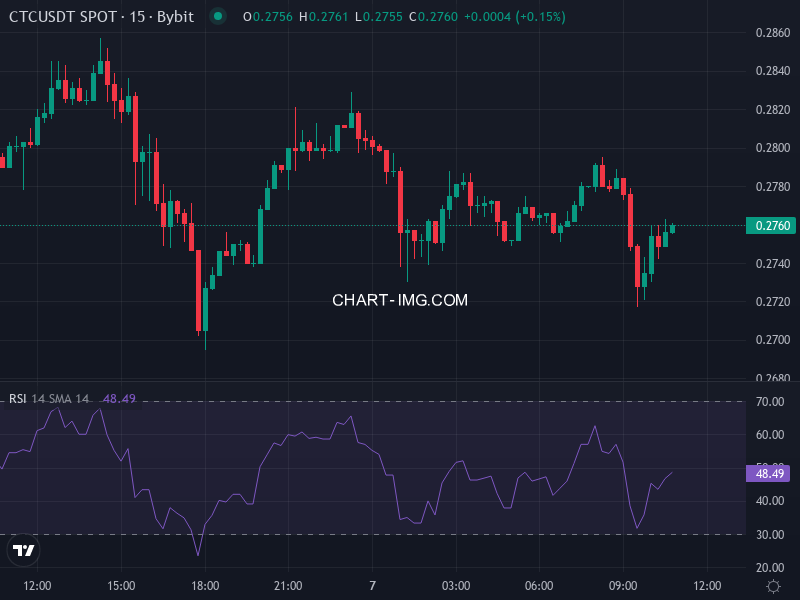
Right now, Creditcoin is trading around $0.27524, down about 1.42% in the last 24 hours. That puts it hovering just above some critical support levels, but still facing a tough uphill climb against resistance. The chart isn’t exactly screaming “buy” right now, but there are some levels worth watching closely.
What the Indicators Are Saying
The moving averages paint a cautious picture. CTC is trading below both its 50-day average at $0.2827 and way below its 200-day at $0.4621. That’s textbook downtrend territory—the kind of setup where rallies tend to get sold into rather than followed. The RSI sits around 53, which is neutral ground but leaning toward tired momentum. MACD readings echo that weakness, showing no real appetite for a reversal yet.
On the support side, the first cushion sits at $0.2709. If that breaks, the next safety net is around $0.2625, followed by a stronger floor at $0.2547. Losing that last one could shake confidence and open the door to a slide toward $0.22 or even $0.20.
For any bounce to gain traction, CTC needs to clear $0.2871 first, then $0.2949, and ideally push through $0.3033. Getting above that third resistance level would be the first real sign that the trend might be shifting. Until then, rallies are likely to be short-lived.
Possible Paths Forward
If the bulls show up with volume and push above $0.2871, we could see a test of $0.2949 and maybe a run toward $0.3033. Breaking above that could open up targets in the $0.33 to $0.35 range, though that would need help from broader market strength and continued good news from the project.
On the flip side, slipping below $0.2709 would likely trigger more selling, with $0.2625 and then $0.2547 coming into focus fast. If those levels can’t hold, things could get ugly in a hurry, potentially dragging CTC back toward the low $0.20s.
There’s also a decent chance we just chop sideways for a while between $0.2625 and $0.2949, with no clear direction as traders wait for a catalyst. That kind of range-bound action tends to kill momentum and test patience.
Looking Further Out
Longer-term projections for 2026 suggest CTC could trade anywhere from $0.27 to $1.33, with average prices settling in the $0.60 to $0.70 zone if things go reasonably well. That’s a wide range, which tells you there’s a lot of uncertainty baked in. Most technical indicators still lean bearish or neutral in the near term, so it’s not like the path forward is obvious.
What could change the game? Real adoption. If Creditcoin’s identity tools and credit infrastructure start getting used by actual lending platforms and financial services, that utility could shift sentiment. Partnerships that bring in users—not just headlines—would help too. The dual-chain architecture and focus on real-world assets give it a solid foundation, but foundations don’t move prices on their own. Execution does.
For now, caution seems warranted. The chart suggests more downside risk than upside potential in the short run, but for those with patience and a longer timeframe, the fundamental pieces are quietly falling into place. Just don’t expect fireworks tomorrow.