

Regulatory Clarity Meets Real Infrastructure
DoubleZero launched its mainnet-beta on October 2, 2025, rolling out the native token 2Z alongside a DePIN (Decentralized Physical Infrastructure Network) designed to cut latency and boost throughput. The network now operates more than 70 high-performance fiber links spanning over 25 locations globally. Heavy hitters from the Solana ecosystem—Jump Crypto, RockawayX, and Galaxy—are already running infrastructure nodes, and early throughput data shows meaningful improvements in validator communication speeds.
What really caught the market’s attention, though, was the regulatory green light. The U.S. SEC’s Division of Corporation Finance issued a No-Action Letter confirming that 2Z doesn’t qualify as a security under the Howey Test. The reasoning is straightforward: tokens are distributed programmatically as rewards for actual work—validating data, contributing bandwidth—not as passive investment vehicles promising future profits. That distinction opened the door for major exchange listings, including Coinbase, and brought institutional players to the table.
Early price action was driven by speculation, with sharp spikes shortly after launch. But as the initial hype faded, the price settled into a more measured range, reflecting expectations tied to actual network usage rather than pure momentum. The combination of regulatory legitimacy and working infrastructure has shifted sentiment from speculative to foundational, even if the charts haven’t quite caught up yet.
What the Charts Are Saying
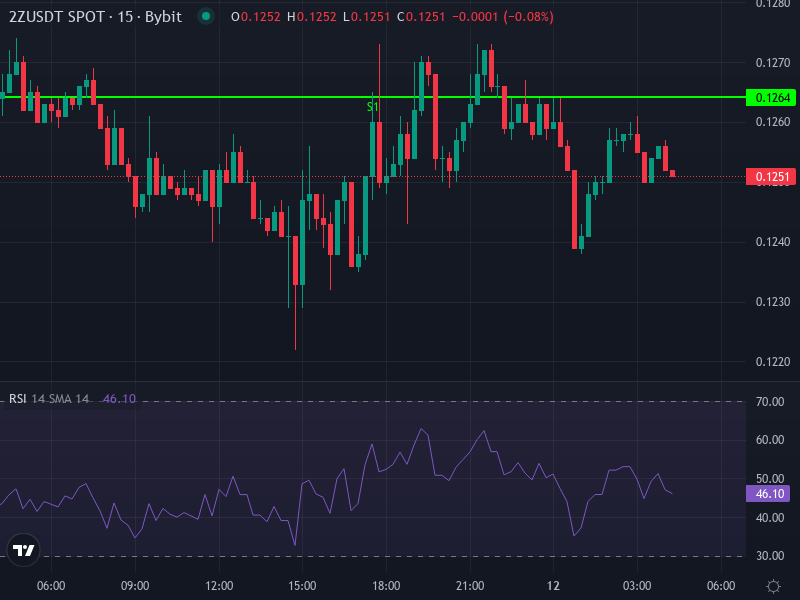
As of now, 2Z/USDT is trading around $0.12527, down roughly 1% over the past day. The price is testing some key technical levels, and the signals are mixed but leaning cautious.
On the 4-hour chart, the Relative Strength Index sits near 43—not quite oversold, but closer to that zone than overbought territory. That suggests limited downside risk, but it also means there’s no strong buying pressure building yet. The MACD tells a more bearish story: the MACD line is below its signal line, and the histogram remains negative, pointing to ongoing downward momentum.
Short-term moving averages are acting as resistance. The 4-hour Simple Moving Average is around $0.13137, and the Exponential Moving Average is near $0.12906—both above the current price. That puts a lid on upside movement in the $0.129 to $0.131 range unless buyers step in with conviction.
Daily pivot analysis shows immediate resistance at $0.13440 (R1), $0.13939 (R2), and $0.14239 (R3). Support levels sit at $0.12641 (S1), $0.12341 (S2), and $0.11842 (S3). Right now, the price is flirting with S1, which means this support level is under pressure. If it holds, we could see a bounce. If it breaks, the next stop is likely S2 or lower.
Two Paths Forward
If Buyers Show Up
Should the $0.1264 support level hold and buyers defend it with volume, 2Z could climb back toward the $0.129–$0.131 resistance zone. Breaking above the 4-hour moving averages would signal a shift in momentum and open the door to R1 at $0.13440. From there, if network adoption picks up or more institutional interest flows in post-Coinbase listing, R2 ($0.13939) and even R3 ($0.14239) become realistic targets. That scenario depends on fresh catalysts—whether from infrastructure growth, staking activity, or broader market sentiment turning bullish on DePIN projects.
If Sellers Stay in Control
On the flip side, if resistance around $0.129–$0.131 holds firm and sellers maintain pressure, 2Z could slip below S1 and head toward S2 near $0.12341. A sustained move below $0.118 would mark a deeper correction, likely triggering stop-losses among short-term holders and pushing the price into more bearish territory. This scenario plays out if network usage lags expectations, broader crypto markets weaken, or profit-taking from early buyers continues.
What Traders and Investors Should Watch
For short-term traders, the key is confirmation. Look for bullish engulfing candles, volume spikes on breakouts, or divergence in the MACD histogram—like shrinking negative bars even as price makes new lows. Those can signal an impending reversal. The $0.1264 support and $0.129–$0.131 resistance zone are the critical thresholds to monitor.
Long-term investors should focus on fundamentals. How fast is the network scaling? Are validators and users actually routing traffic through 2Z infrastructure? Is staking volume growing? How quickly are new fiber links and geographic nodes coming online? The SEC no-action letter removes a major regulatory overhang in the U.S., but international adoption will depend on how other jurisdictions treat DePIN tokens and whether DoubleZero can maintain compliance across borders.
Risk management is non-negotiable here. Volatility is part of the game, especially with a relatively new asset still finding its footing. Leverage magnifies both gains and losses, so tread carefully. Entry points near validated support levels offer better risk-reward setups than chasing breakouts without confirmation.
The near-term picture for 2Z is cautious but not dire. Immediate upside is limited without breaking through resistance, but the recent regulatory win and live infrastructure give the project a solid foundation. If real demand materializes—whether from network growth, staking, or broader DePIN adoption—prices could push toward the $0.13–$0.15 range over the coming months. Failure to hold support, however, might see 2Z test the lower $0.12 range. The next few weeks will likely be decided by what happens between $0.126 and $0.131. That’s where the battle lines are drawn for now.