
Big Changes to Token Economics and Platform Expansion
dYdX has been busy upgrading its platform and reworking how value flows back to token holders. Late last year, the community voted to dramatically increase the share of protocol fees used for buying back DYDX tokens—jumping from 25% all the way to 75%. That’s a huge shift designed to create steady buy pressure and shrink the circulating supply over time.
On top of that, dYdX launched spot trading for U.S. users and opened up zero-fee spot markets on Solana. Both moves expand their user base and give DYDX more real-world utility. From a fundamental standpoint, these are positive tailwinds that should support the token’s value long-term.
But it hasn’t all been smooth sailing. Security issues cropped up recently with malicious code packages targeting dYdX developers in both NPM and PyPI repositories. While the damage was contained, it’s a reminder that infrastructure vulnerabilities are real. There was also a past incident where validator failures caused unintended user liquidations. These kinds of hiccups put trust and reliability under the microscope, and they matter when you’re trying to build confidence in a decentralized exchange.
Where the Price Stands Right Now
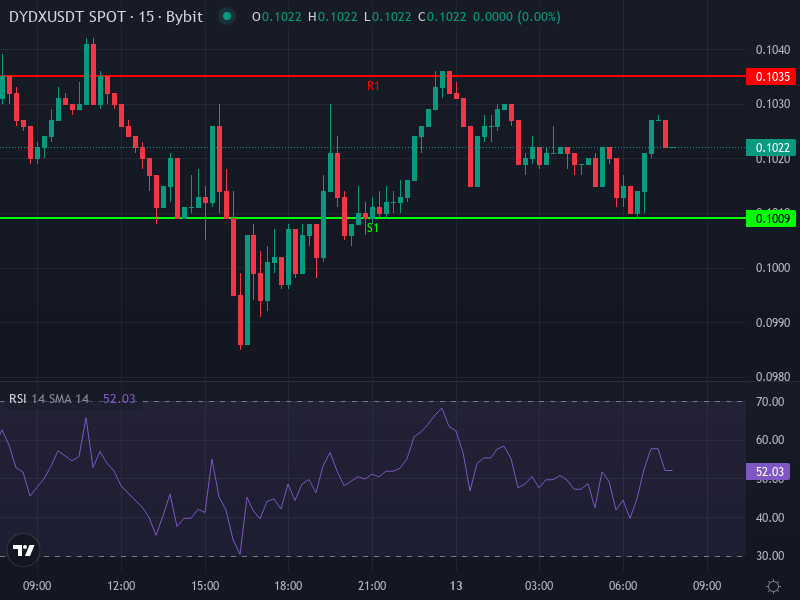
As of writing, DYDX is trading around $0.1022, down about 0.81% on the day. It’s hovering near a daily pivot point, with resistance just overhead at $0.1048 and $0.1095. On the downside, support sits at $0.0973, then $0.0944, with a stronger floor around $0.0898.
Looking at the 4-hour chart, momentum is tepid at best. The RSI sits at 45.6—below the neutral 50 mark—which tells you buying interest is subdued. The MACD line is slightly under its signal line, though the histogram just turned barely positive. That could hint at a shift if buyers show up, but right now it’s more of a question mark than a confirmation.
Zooming out to longer timeframes, both the 50-day and 200-day moving averages are still well above the current price. That confirms the bigger picture remains bearish. Most algorithmic sentiment models echo that view, with the majority of indicators leaning negative. Without a significant catalyst—either from the market or from dYdX’s own tokenomics—further downside seems more likely in the short term.
Three Paths Forward: Bearish, Bullish, and Sideways
If Bears Stay in Control
Should selling pressure continue, the next zone to watch is between $0.089 and $0.095. If that support breaks, we could see a move toward $0.08 or lower. Warning signs would include weak volume, failure to hold above the $0.1022 pivot, and the MACD staying in negative territory with RSI dipping below 40. Anyone holding positions should consider tight stop-losses just beneath key support levels to limit damage.
If Bulls Make a Comeback
For a bullish reversal to take hold, DYDX needs to break cleanly above $0.1048 to $0.1095 on solid volume. If that happens and the MACD flips positive with expanding green bars on the histogram, we could see a push toward $0.12 or higher. The improved tokenomics—especially the increased buyback allocation—and new platform features give bulls ammunition. Reclaiming the 50-day and 200-day moving averages would be a game-changer, though that’s a tall order given the current setup.
Stuck in the Middle
There’s also a decent chance DYDX just chops around between $0.098 and $0.104 for a while. In this scenario, expect choppy, low-conviction trading with neither side winning decisively. Momentum indicators would likely flatten out, and volatility would drop. Unless there’s a major external push—like a broader crypto rally, regulatory clarity, or a standout announcement from the dYdX team—don’t expect fireworks. Patience and tight risk management become even more important in a range-bound environment.