Where Things Stand Right Now
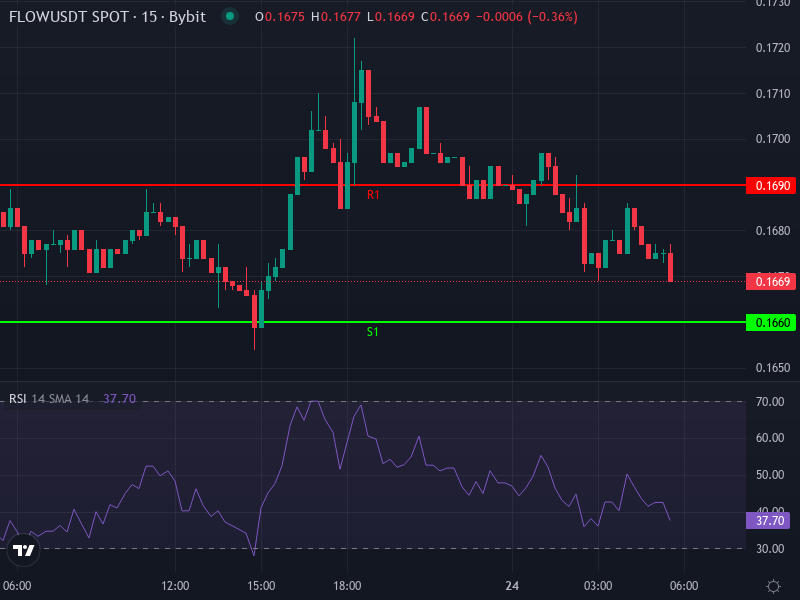
FLOW is hovering around $0.1673 USDT, drifting lower over the past day as selling pressure continues to weigh on the token. Behind the price action, there’s actually some interesting movement happening in the Flow ecosystem. Dapper Labs is trying to rebrand itself—moving away from being known primarily as “that NFT platform” toward building serious DeFi infrastructure and consumer finance tools. They’re rolling out protocol-level changes designed to make FLOW deflationary when network activity picks up, which sounds promising on paper.
But there are headwinds too. Canadian tax authorities are sniffing around NFT activity, creating some short-term uncertainty. On the positive side, Upbit has restored deposits and withdrawals, which should help liquidity. Still, trading volumes remain pretty quiet compared to what we’ve seen in busier periods.
What the Charts Are Telling Us
Looking at the 4-hour chart, FLOW’s Relative Strength Index (RSI) is sitting near 35. That’s weak, no question, but it’s not screaming “oversold” just yet. The MACD line is barely above the signal line, and both are hanging out below zero with a tiny positive histogram—translation: there might be room for a small bounce, but don’t expect any fireworks.
The 4-hour moving averages (both Simple and Exponential) are clustered around $0.1726–$0.1727, acting as immediate resistance. On the daily timeframe, resistance levels stack up between $0.169 and $0.172, while support zones sit near $0.165 and $0.163. The pivot point is hovering around $0.168.
Here’s the kicker: when you zoom out to the 50-day and 200-day moving averages—which are way up in the $0.23–$0.35 range—FLOW is trading miles below its longer-term trend lines. Market sentiment indicators, including RSI readings in the mid-20s and a low Fear & Greed Index, all point to a bearish mood with maybe some short-term oversold conditions brewing.
Key Levels to Watch
- Immediate resistance: $0.169–$0.172 — FLOW needs to push through here to change the short-term narrative.
- Immediate support: $0.165–$0.163 — if this breaks, things could get ugly fast.
- Long-term resistance: Around $0.23 and above, where the 50-day moving average lives. Getting there would require a much stronger rally.
What Might Happen Next
Based on what we’re seeing now, a couple of scenarios look most likely over the coming weeks:
The bullish case: If FLOW can push back above $0.169–$0.172 with solid volume—and actually close above those levels on several 4-hour candles—we could see a move toward $0.180–$0.185. That would need the MACD to confirm the turn, RSI climbing above 50, and price breaking above those nearby moving averages.
The bearish case: If support at $0.165–$0.163 gives way, we’re probably looking at $0.155 or lower. Given weak sentiment and thin liquidity, downside momentum could pick up steam, especially if the broader crypto market catches a case of the jitters.
There’s also the possibility of just… nothing happening. FLOW could grind sideways between $0.163 and $0.172 in choppy, range-bound trading until something—good DeFi news, regulatory clarity, or a macro shift—gives it direction. Right now, the technicals favor sellers, even though those oversold indicators leave the door open for a bounce.
What This Means for Traders and Investors
If you’re trading short-term, keep your eyes on those resistance and support zones. A break either way could move fast. Consider tight stop-losses just under $0.163 to protect yourself from sudden drops, and size your positions to match the volatility—which, while elevated, isn’t as wild as it’s been in previous months.
For long-term holders, there’s an interesting story developing with FLOW’s pivot toward DeFi and potential deflationary mechanics. But let’s be real: with price this far below longer-term moving averages, buying now carries real risk unless you see clear signs of a trend reversal. If you’re patient and willing to accumulate at support, you’ll want to see actual ecosystem growth and institutional money flowing in before getting too excited.