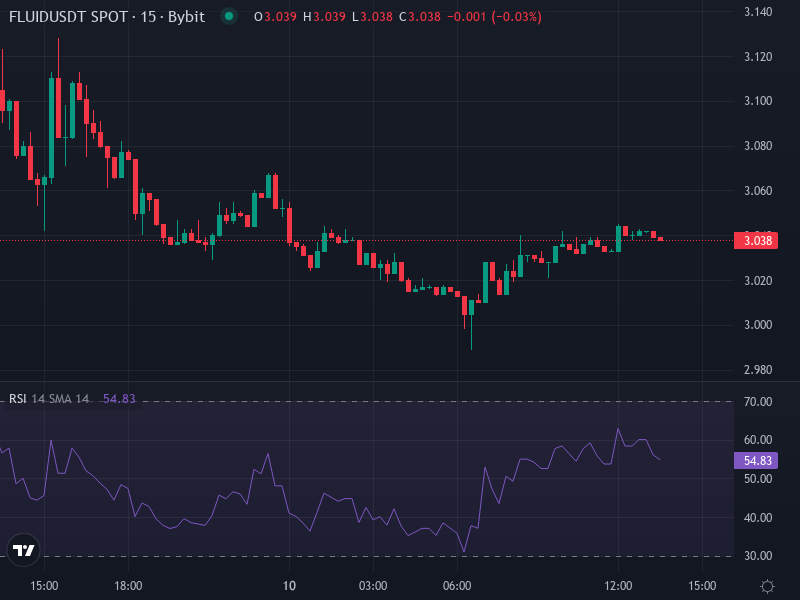

What’s Happening with FLUID Right Now
FLUID is currently trading around $3.04, down roughly 1.93% over the past 24 hours. The token has been dealing with increased volatility lately, partly due to broader uncertainty across the DeFi space and shifting macroeconomic conditions. With about 77 million tokens in circulation out of a total supply of 100 million, FLUID sits at a market cap near $233.7 million. Daily trading volumes remain relatively modest—often in the low millions—which means liquidity can be thin and price moves somewhat exaggerated.
On the development front, the Fluid protocol has been steadily executing its roadmap. The team continues to expand multi-chain integrations, refine both DEX and lending features, and strengthen tokenomics through mechanisms like revenue-driven buybacks. That said, concerns persist around potential impermanent loss in leveraged liquidity provider positions and the risk of undercollateralization during sharp market swings. So we’re seeing a mix of cautious optimism—believers point to solid fundamentals, while skeptics worry about execution risks and external headwinds.
Technical Picture and Price Outlook
From a technical standpoint, FLUID appears to be entering a mildly bearish phase in the near term. Key moving averages like the 10-day and 20-day EMAs are trending downward, signaling recent selling pressure. The Relative Strength Index sits in the 30–40 range, suggesting limited buying momentum without hitting deeply oversold territory just yet. Meanwhile, the MACD recently crossed bearish, and momentum indicators like Williams %R and Stochastic RSI hint at possible short-term bounces, though without strong bullish signals backing them up.
Support levels are clustered around $2.30 to $2.50, with the strongest zone likely sitting near $2.50. On the upside, resistance appears between $2.70 and $3.10, with a tougher barrier emerging around $3.20–$3.30 where prior consolidation occurred.
At the current price near $3.03, FLUID is essentially sitting at a decision point. If buyers can push through the $3.20 resistance with solid volume, we could see a move toward $3.50 or even test $4.00 in a stronger rally scenario. On the flip side, if resistance holds and selling pressure picks up, a retest of $2.70 seems likely—or even deeper toward $2.30 if things turn more bearish. Given the thin liquidity, expect choppy and potentially sharp moves in either direction.
Short-Term vs. Longer-Term Expectations
Next 1–2 Weeks: Price will likely stay range-bound between roughly $2.70 support and $3.30 resistance, with occasional volatility spikes. Without fresh catalysts—like major protocol upgrades, new exchange listings, or positive macro news—momentum leans slightly bearish. A breakdown below $2.70 could trigger a slide toward $2.50.
1–3 Months Out: If Fluid delivers on its promises—successful cross-chain rollouts, improved DEX functionality, or tangible results from revenue buybacks—we could see the token reclaim $3.50 and push toward $4.00–$4.50. However, if broader market conditions sour or protocol issues emerge, a deeper pullback toward $2.30–$2.50 becomes more realistic, where longer-term holders might step in.
Key Risks and What to Watch
Several factors could push FLUID higher: successful protocol upgrades, increased total value locked across chains, growing revenue, and improved market sentiment. On the downside, negative social chatter, reports of losses from leveraged LP positions, or regulatory crackdowns on DeFi could accelerate selling. Volume will be crucial—any breakout above resistance without strong volume is likely to fizzle.
Important price levels to monitor:
- Support: ~$2.70, then ~$2.50, with deeper support near ~$2.30
- Resistance: ~$3.20–$3.30, followed by ~$3.50 if a breakout gains traction
Bottom line: FLUID is in a holding pattern right now. Until either resistance gets decisively broken or support gives way, expect continued volatility and sideways action around current levels.