Where GALA Stands Right Now
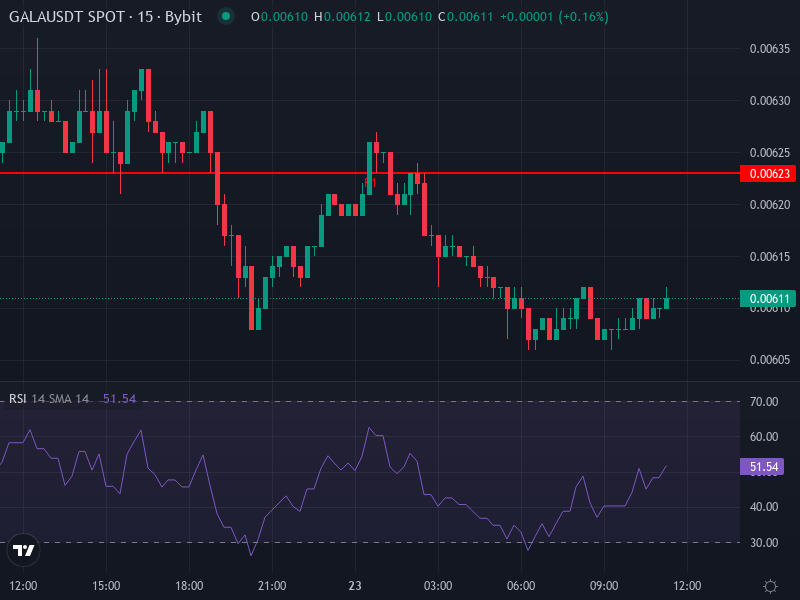
GALA is currently trading around $0.00607, down roughly 2.47% over the past 24 hours. The recent slide comes after the token broke through a key support level near $0.007—a threshold that had been holding since earlier in the month. This breakdown triggered automated stop-losses and opened the door to further selling pressure.
The weakness isn’t happening in isolation. Across the broader crypto market, liquidity has been draining from altcoins as Bitcoin dominance climbs and risk appetite fades. GALA, like many gaming and metaverse tokens, has felt the squeeze particularly hard. Meanwhile, the Gala ecosystem has been rolling out new features—GalaPump’s pre-sale tools, fresh incentives on GalaSwap and GalaChain, and plans for a compliance bridge into China. These developments sound promising on paper, but the market hasn’t responded yet. Adoption is still early, and traders seem to be waiting for real traction before committing capital.
What the Charts Are Telling Us
The technical picture leans bearish, though not dramatically oversold. On the four-hour chart, the Relative Strength Index sits around 43—a neutral zone that suggests neither panic selling nor strong buying interest. The MACD shows a slight bullish crossover, but the histogram bars are weak, meaning any upward momentum lacks real conviction. Moving averages on multiple timeframes are sitting above the current price, acting as overhead resistance. The 50-day and 200-day moving averages are particularly stubborn, reinforcing the idea that sellers still have the upper hand.
Support and resistance levels are tightly clustered right now. The daily pivot sits at $0.00614, with immediate support around $0.00602 and $0.00593. Below that, the next meaningful floor is near $0.00580. On the upside, GALA faces resistance at $0.00623 and $0.00635. Breaking above those levels would require a sharp increase in volume and buyer commitment—neither of which are present at the moment.
Volume has been declining steadily, a sign that buyers are stepping back. Momentum indicators like Williams %R and the Commodity Channel Index are deep in oversold territory, which often hints at a potential bounce. But without follow-through buying or a catalyst to shift sentiment, any relief rally is likely to be short-lived and met with fresh selling.
Key Levels to Watch
If selling continues, watch for support between $0.00590 and $0.00580. A breakdown below that zone could open the door to $0.00550, especially if Bitcoin weakens or broader altcoin markets deteriorate further. On the flip side, reclaiming $0.00620 to $0.00625 would be the first sign of a meaningful recovery. A sustained move above $0.00635 could set the stage for a push toward $0.00650, but only if accompanied by strong volume and a clear shift in market sentiment.
Price Outlook: What to Expect Next
Short Term (Next 1-3 Weeks): GALA is likely to trade in a range between $0.00590 and $0.00625. If the RSI dips further into oversold levels, a bounce back toward the pivot at $0.00614 is possible. But breaking above $0.00625 looks difficult right now, given the lack of buying pressure and the weight of overhead resistance. In a worst-case scenario where support at $0.00590 fails, expect a drop toward $0.00550.
Medium Term (1-3 Months): For GALA to stage a real recovery, a few things need to happen. First, the ecosystem needs to prove itself—adoption of GalaPump, meaningful activity on GalaChain, and usage of the new compliance bridges. Second, selling pressure from token emissions and large holders needs to ease. Third, GALA needs to break and hold above $0.00650 to $0.00675 with strong volume. If those conditions align and the broader altcoin market improves, there’s a path back toward the mid-$0.007 range and potentially higher. Without those catalysts, GALA could continue drifting sideways or lower, consolidating near or below $0.00580.
GALA’s tokenomics add another layer of complexity. The protocol emits 0.25% of the difference between total and maximum supply each day, creating steady inflation. Utility burns happen through gas fees and NFT activity on GalaChain, which could offset some of that pressure—but only if usage picks up significantly. If adoption lags or development milestones slip, the bearish trend could persist for longer than many holders would like.