Where Things Stand Today
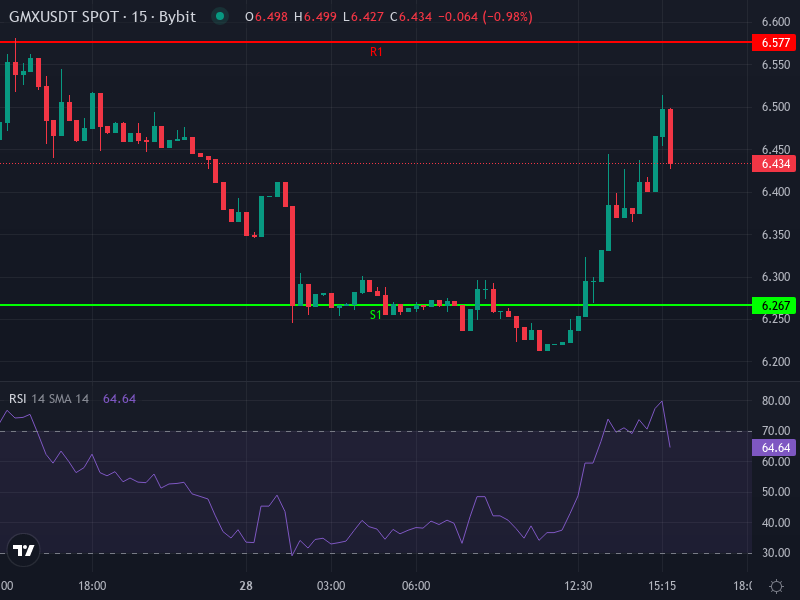
GMX is currently trading around $6.46, down about 1.28% over the last 24 hours. The token finds itself in a bit of a holding pattern—neither breaking out nor breaking down in any meaningful way.
On the technical side, the 4-hour RSI sits at roughly 52.6, which is about as neutral as it gets. There’s no obvious buying or selling pressure dominating right now. The MACD tells a similar story, hovering just below its signal line with a slightly negative histogram. In plain English, that means momentum is leaning bearish, but not aggressively so.
The short-term moving averages paint an interesting picture. The simple moving average is at $6.43 and the exponential at $6.40. With price just above both, GMX has a bit of cushion, but not much room to celebrate. It’s basically treading water right above support.
Daily pivot analysis gives us clearer battle lines. The main pivot sits at $6.39. Above that, resistance levels stack up at $6.58, $6.70, and $6.89. Below, support zones appear at $6.27, $6.08, and $5.96. These aren’t arbitrary numbers—they’re where buyers and sellers have historically shown up.
Recent Protocol Updates and What They Mean
Behind the price action, GMX has been busy shipping updates. Version 2.2 of the protocol just rolled out with gas optimizations, better cross-chain functionality, and lower transaction costs. The team’s roadmap includes v2.3 arriving late 2026 or early 2027, bringing cross-margin trading and unified market groups.
If executed well, these changes could strengthen the economic structure underneath GMX. But the market rarely prices in distant promises, especially in crypto.
More immediately relevant is the Chainlink oracle integration on Arbitrum. Oracle latency dropped from around 60 seconds to just 15 seconds for major assets. That’s a big deal for perpetual traders—tighter execution, better stop-loss reliability, and reduced liquidation risk. For a derivatives-focused protocol like GMX, infrastructure improvements like this matter more than flashy announcements.
What to Watch Next
In the short term, GMX looks likely to chop around between $5.97 and $6.70. Without a volume spike or catalyst, breaking out of this range will be tough. The current technical setup suggests more downside risk than upside opportunity over the next few weeks, especially if broader crypto markets stay flat or turn negative.
If price slips below the $6.27 support level, the next stop is probably $6.08, with $6.00 as a psychological floor. On the flip side, a convincing break above $6.57 would be the first sign that bulls are regaining control. From there, $6.70 becomes the next test, and if that clears, $6.90 comes into play.
Key Levels for Traders
Support to watch: $6.27 and $6.08. If these break, things could get uncomfortable quickly.
Resistance to clear: $6.57 first, then $6.70. Without strong volume, rallies will likely stall at these levels.
Momentum signals: Keep an eye on MACD crossovers and RSI movement outside the neutral zone (below 40 or above 60). These will help clarify whether bulls or bears are taking control.
Looking further out, if GMX can deliver on its roadmap and maintain reliable infrastructure, there’s room for a move back above $7.00. But that’s a story for the coming months, not weeks. Without a catalyst—whether that’s major partnerships, chain expansions, or a surge in trading volume—the path to $7.50 or higher remains distant.
For now, GMX is consolidating, and patience is probably the right play. Watch the key levels, follow the volume, and let the market show its hand before making bold bets either direction.