A Major Shift in Tokenomics
GMX is going through something pretty unusual right now. Back in early March 2026, the GMX DAO voted to hit pause on all staking rewards until the token price climbs back up to around $90. That’s a long way from where we are today—hovering near $6. Instead of paying out rewards to stakers, the protocol is now funneling those fees into its treasury and using them to buy back tokens from the open market. The idea is simple: reduce the circulating supply, create deflationary pressure, and hopefully push the price higher over time.
It’s a bold move, and whether it works depends entirely on whether users keep trading on the platform and whether liquidity providers stick around despite the lack of immediate rewards. If adoption holds steady or grows, this could stabilize the price and set GMX up for a real recovery. But it’s also a risky bet—asking the community to wait for a 15x price increase is no small thing, and there’s always the chance that traders drift toward competing platforms in the meantime.
On the infrastructure side, GMX has been shoring up its backend. The platform recently integrated RedStone oracles to provide real-time pricing for GLP liquidity tokens. This might sound technical, but it matters—better price feeds mean safer collateral, more accurate liquidations, and less risk for people using leverage. It’s the kind of upgrade that doesn’t make headlines but quietly builds confidence in the system.
What the Charts Are Saying Right Now
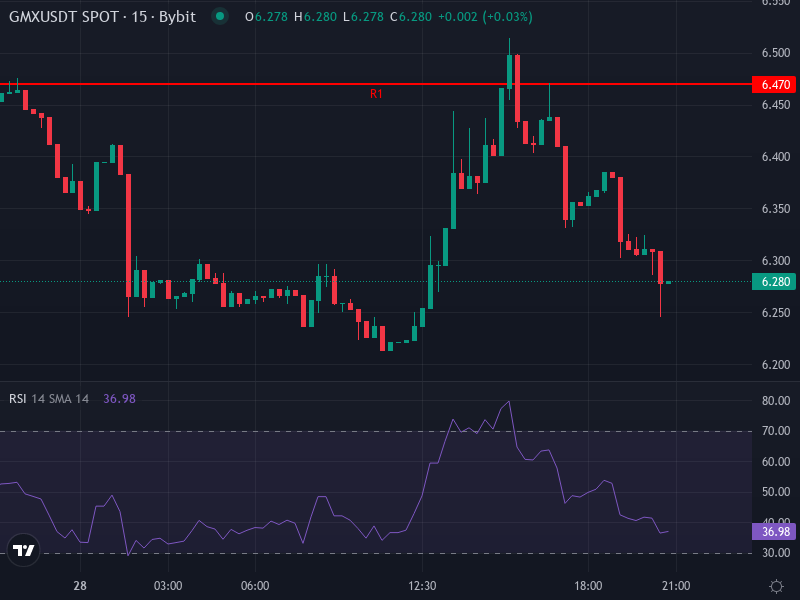
As of the latest data, GMX is trading at about $6.28, down roughly 2.8% over the past day. Looking at the 4-hour chart, the Relative Strength Index sits around 46—pretty neutral territory, leaning just slightly bearish. The token isn’t oversold, but it’s not exactly attracting fresh buying pressure either.
The 4-hour Simple Moving Average is up at $6.42, and the Exponential Moving Average is a bit lower at $6.38. Right now, price is sitting below both, which means there’s resistance overhead. If GMX wants to rally, it’ll need to push through that $6.40 to $6.45 zone with some real volume behind it. The MACD is also showing a mild bearish signal—the MACD line is just under its signal line, and the histogram is slightly negative. That tells us momentum is weak and sellers have a slight edge in the short term.
Support levels to keep an eye on are around $6.16 and $6.03 if things turn south. On the upside, immediate resistance is near $6.47, with stronger barriers around $6.65 to $6.78. If the price can’t reclaim that moving average soon, we’re probably looking at more sideways action or a test of lower support.
Where GMX Could Be Headed
Short Term (Next Few Weeks)
In the near term, GMX looks likely to stay locked in a range between $6.00 and $6.60. There’s resistance overhead and no strong momentum signal to suggest a breakout is imminent. If buyers show up and push through $6.50 with decent volume, we could see a run toward $6.78. On the flip side, a break below $6.00 would open the door to $5.85 and potentially lower. Any positive news—like a surge in trading volume, strong buyback activity, or new partnerships—could spark a short-term bounce.
Medium Term (Next Few Months)
Over the next one to three months, the tokenomics shift should start to show its effects. If GMX can maintain or grow its user base and trading volume, the buyback pressure could push the price toward $8 to $10. That would be a solid recovery and a sign that the strategy is working. But if volume dries up or other perpetual DEXs start pulling market share away, we could see GMX drift back down toward $4 or $5 instead. Holding above $7 for a sustained period would be a strong bullish signal that momentum is shifting.
Long Term (Rest of the Year and Beyond)
Getting to that $90 target the DAO set is going to take a lot more than just buybacks. GMX would need massive growth—more users, deeper liquidity, multichain expansion, and sustained demand across a full market cycle. In the most optimistic scenario, where everything goes right—protocol upgrades land smoothly, oracle improvements attract institutional interest, and the broader crypto market stays strong—GMX could realistically climb into the $50 to $100 range over the next year or two.
But there’s also a more conservative path where GMX stays range-bound between $5 and $15 for most of the year. If the macro environment turns sour, or if faster and cheaper competitors eat into GMX’s market share, the big rally might not materialize. A lot depends on execution, market sentiment, and how well the team can keep innovating while managing the risks of a long reward freeze. It’s a high-stakes play, and the outcome is far from certain.