Context and Recent Developments
Gravity, developed by Galxe, has recently rolled out substantial technical upgrades that are worth paying attention to. The platform’s Grevm 2.0 now achieves sub-second finality and can handle between 7,000 and 8,000 transactions per second on its Devnet, with ambitions to push toward 10,000 TPS down the road. Under the hood, Gravity uses an Aptos-inspired parallel EVM execution engine called Reth and runs on the Jolteon consensus protocol. The project has also integrated restaking mechanisms through Babylon and EigenLayer to strengthen its proof-of-stake foundation.
But here’s the catch: despite these impressive technical achievements, the token faces some serious headwinds. More than 70% of the supply is concentrated in just five wallets, which always raises centralization concerns. Add to that the broader market sentiment sitting in “Extreme Fear” territory and Bitcoin dominance rising, and you’ve got a challenging environment for any altcoin trying to gain momentum. The fundamentals might be strong, but macro conditions and token distribution are creating real friction for short-term price action.
Technical Indicators and Price Action
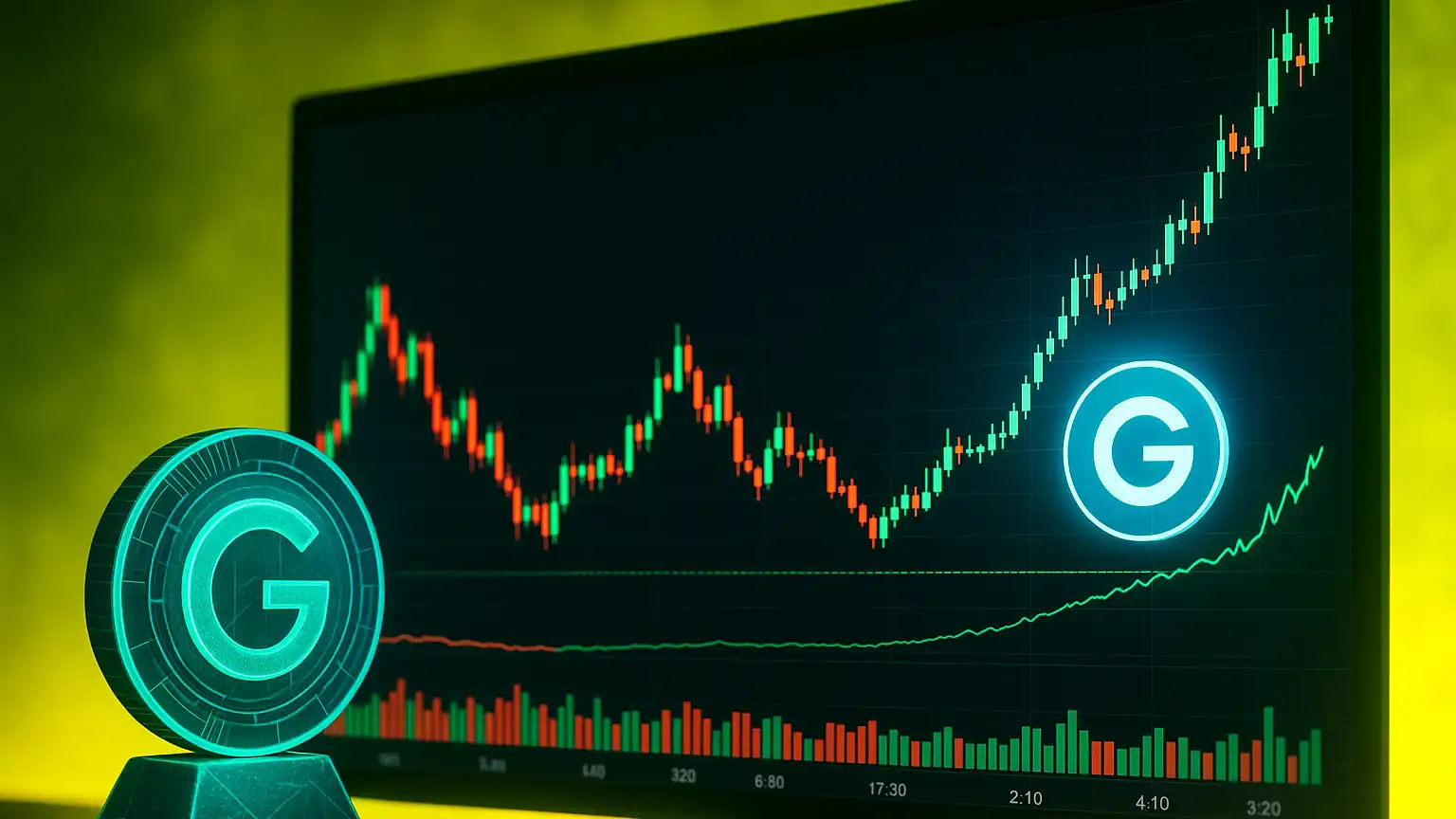
Right now, G/USDT is trading around $0.004519 and showing a mixed technical picture that leans slightly bearish. Looking at the 4-hour timeframe, the RSI is hovering near 49—essentially neutral territory, neither overbought nor oversold. The MACD tells a similar story of indecision: it’s slightly negative with a small positive histogram hinting at weak bullish divergence, but the MACD line still sits below the signal line. That means there’s no strong confirmation of any trend reversal just yet.
The moving averages paint a conflicting picture too. The 4-hour simple moving average sits below the current price, which would normally suggest bullish momentum, but the exponential moving average is above it, acting as a resistance level. This tug-of-war between indicators reflects the uncertainty traders are feeling right now.
Daily pivot point analysis gives us some concrete levels to work with. The main pivot sits at $0.004560, with support zones between $0.004440 and $0.004230, and resistance layers stretching from $0.004650 up to $0.004860. The longer-term moving averages continue to press down from above, clustering around $0.00450 to $0.00460, which creates a ceiling that price needs to break through convincingly.
Short and Mid-Term Outlook
Next Few Days
Based on current momentum patterns and pivot structure, Gravity will likely test resistance somewhere between $0.00465 and $0.00475 in the coming days. If buyers can’t push through that zone with solid volume, we’ll probably see price drift back down to support levels around $0.00444 to $0.00435. That support should hold unless we get hit with unexpected negative catalysts or see large coordinated selling. The 4-hour EMA near $0.00457 is the immediate hurdle—a clean break above it with decent volume could open the door toward $0.0050.
Weekly to Monthly Projection
Zooming out a bit, G is stuck in a consolidation pattern with declining volume, which isn’t exactly encouraging. Sentiment indicators are tilting bearish, and there are significant resistance zones between $0.00530 and $0.00580 that will be tough to crack without a broader crypto market recovery. Most algorithmic forecasts are actually pointing toward a potential drop to the $0.00330 to $0.00370 range over the next few weeks if current support levels fail to hold.
That said, there’s always the flip side. If Gravity’s ecosystem starts showing real traction—think actual dApp deployments, growing transaction volumes, and positive announcements—we could see price revisit levels above $0.006. But honestly, that would require a meaningful shift in both macro sentiment and liquidity conditions across the altcoin market. The technology is there, but the market needs to care about it again.
Risks and Key Levels to Watch
The main risks here are pretty clear: extreme token centralization, ongoing liquidity drain toward Bitcoin, and the potential failure at key resistance tests. Here are the critical levels to keep on your radar: support between $0.0042 and $0.0044 is your first line of defense. On the upside, watch for resistance at $0.00460, then $0.00480 to $0.0050. A decisive daily close above $0.0053 to $0.0055 would actually start to build a legitimate bullish case. Conversely, a break below $0.0042 could trigger sharper corrections down toward $0.0035 or lower.
Beyond price levels, keep an eye on on-chain metrics and sentiment indicators—they’re probably more important than the technical patterns right now. Look for daily trading volume consistently above $100 million, sustained positive shifts in RSI, and any signs that large holders are reducing their movements. Those would be early signals of a possible bullish reversal. Until then, caution is warranted despite the impressive technology backing the project.