

Where Things Stand Right Now
io.net just hit a pretty significant milestone—over $20 million in total network earnings. That’s not just a number to celebrate; it shows real, accelerating demand for decentralized GPU compute power. The platform now operates across more than 130 countries and offers developers GPU resources at around 70% less than what they’d pay AWS or Google Cloud. That kind of pricing advantage is hard to ignore, especially for AI labs and research teams working on tight budgets.
But it hasn’t all been smooth sailing. Recently, io.net dealt with a security incident—an API-level attack that didn’t compromise user hardware but did shake confidence and led to a drop in active GPU nodes. The team responded quickly with fixes, but the episode highlighted some growing pains in maintaining reliability at scale.
On the tokenomics front, there’s a big shift coming. The proposed Incentive Dynamic Engine (IDE) is designed to cut the circulating supply of IO tokens by half before the middle of 2026. If executed well, that supply squeeze could provide serious upward support for the token’s price. The reform ties supply directly to actual compute usage, which makes sense from an economic standpoint—but it also introduces execution risk if timelines slip or implementation runs into trouble.
Reading the Technical Picture
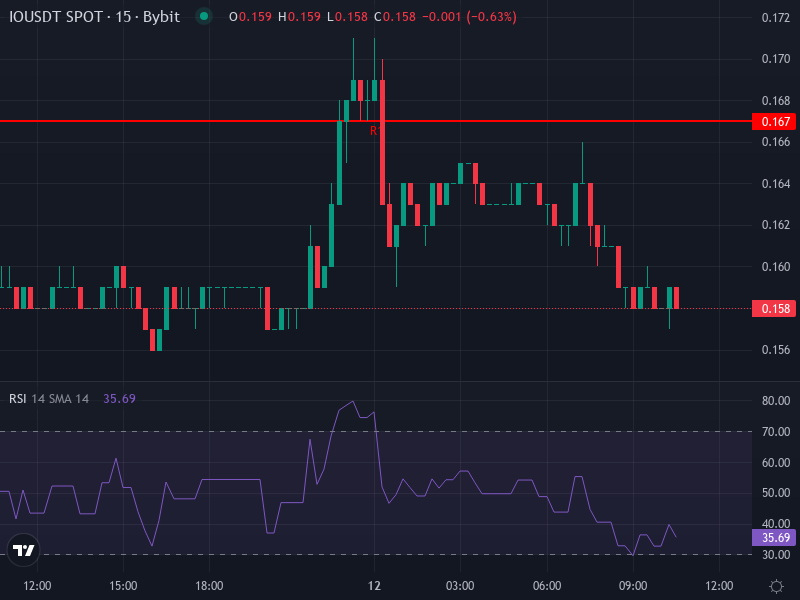
Right now, IO/USDT is trading around $0.1581, down slightly over the past 24 hours. The technical setup doesn’t inspire much confidence in the short term. The Relative Strength Index sits at about 43—neutral territory, leaning a bit bearish. The MACD is showing faint signs of a retracement attempt, but the overall momentum is still tilted downward. Both the 4-hour simple and exponential moving averages are hovering above the current price, which means sellers have the upper hand for now.
Key resistance levels line up between $0.167 and $0.182. On the downside, support waits around $0.152, with stronger floors near $0.147 and $0.137. If IO can’t hold above $0.152, we could see a test of those lower supports fairly quickly. On the flip side, a clean break above $0.167 would signal that buyers are regaining control—but that would need to come with solid volume to be convincing.
Near-Term: The Next Few Weeks
Over the next month or so, expect IO to either consolidate in a tight range or drift lower unless something changes the narrative. A push above $0.162–$0.165 would be the first sign of a shift, but without that, support at $0.152 is likely the next stop. Below that, $0.144 and $0.137 come into play. Watch for the RSI to climb back above 50 and the MACD histogram to flatten out—those would be early hints of a reversal.
Three to Six Months Out
If the tokenomics overhaul happens on schedule and platform usage keeps climbing, IO has a decent shot at testing resistance in the $0.174–$0.200 range. That assumes broader market conditions stay reasonably friendly and execution doesn’t falter. On the downside, if reforms get delayed or network issues persist, we could see IO stuck in a wide channel between $0.130 and $0.180. Some models suggest a floor around $0.129 if bearish momentum takes hold, while more optimistic scenarios push toward $0.18–$0.20.
What Could Move the Needle
There are a few things that could either accelerate IO’s momentum or knock it off course. On the risk side, any further security hiccups would be a problem—trust is hard to rebuild once it’s shaken. The speed at which io.net can restore full GPU node participation matters a lot. Execution risk on the supply cuts is another big one. If the IDE rollout stumbles or gets pushed back, expect volatility.
On the upside, new partnerships or high-profile integrations with major AI workloads could shift sentiment fast. Any announcement of institutional adoption—especially from well-known names in tech or research—would likely trigger a wave of buying interest. And if io.net can keep proving that its cost advantage is sustainable and scalable, that alone could be enough to pull in more developers and investors.
For the next few months, a realistic trading range probably sits between $0.13 and $0.18. Support around $0.144–$0.152 and resistance near $0.174–$0.182 are the zones to watch. If everything goes right—token burns happen on time, usage grows, and a few solid partnerships land—a move above $0.20 isn’t out of the question. But if reforms falter or security concerns linger, $0.10–$0.12 becomes the downside scenario. Keep an eye on active GPU counts, compute transaction volumes, and any macro headwinds. Those will give you the clearest read on where IO is headed next.