

Where Lido Stands in the Staking Ecosystem
Lido DAO has carved out a dominant position in Ethereum’s liquid staking world. As we move through 2026, roughly a third of all staked ETH flows through Lido’s protocol—an impressive achievement that also raises eyebrows about centralization. That concentration creates a double-edged sword: it demonstrates trust and adoption, but it also puts a target on Lido’s back when regulators and decentralization advocates start asking uncomfortable questions.
The team isn’t sitting still, though. Through the “GOOSE-3” initiative, the DAO has proposed a $60 million budget for 2026 aimed at pushing beyond basic staking. The goal is to diversify revenue streams, roll out protocol upgrades, and launch new products like “Lido Earn” vaults. It’s a clear signal that Lido wants to evolve into a broader DeFi infrastructure player, not just ride the staking wave.
On the technical side, Lido V3 introduces stVaults—modular staking environments designed to appeal to institutions and developers who want more customization. The upcoming Staking Router version 3 (SRv3) promises validator consolidation, letting operators combine multiple 32-ETH validators into larger units, plus a new balance-based accounting model. These aren’t just incremental tweaks; they’re meant to cut costs, boost efficiency, and align Lido more closely with where Ethereum staking is headed.
Reading the Charts: Technical Setup and Key Levels
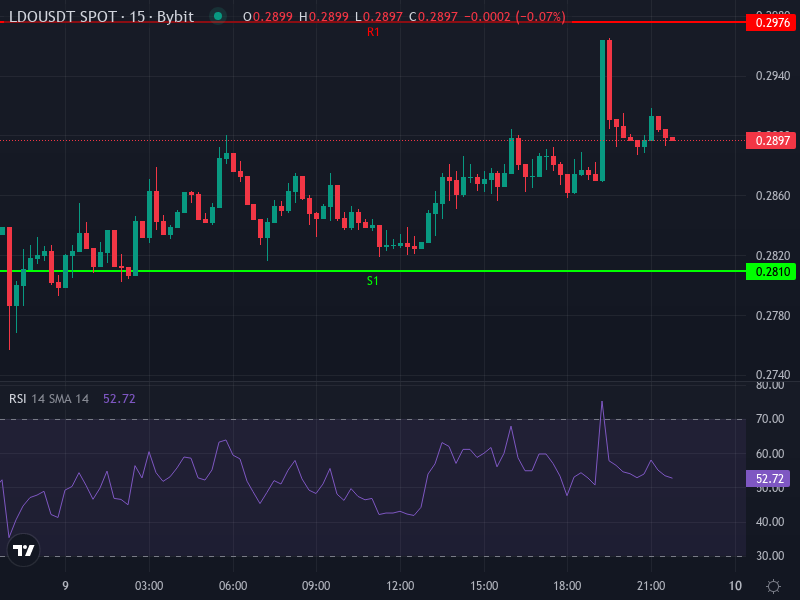
Right now, LDO is trading around 0.2899 USDT, up about 2.24% over the past day. That sounds positive on the surface, but when you zoom into the 4-hour chart, the picture gets murkier.
The Relative Strength Index sits at roughly 47.8—basically neutral territory. It’s not screaming oversold or overbought, just stuck in the middle with no clear momentum. The MACD tells a similar story: the line is sitting just below the signal, creating a tiny negative crossover. There’s a whisper of bullish divergence in the histogram, but it’s too faint to bet on with confidence.
Then there are the moving averages. The 4-hour simple moving average hovers around 0.2954, with the exponential moving average closer at 0.2926. Both are above the current price, acting as a ceiling. Until LDO pushes through those levels, the path of least resistance points down, not up.
Daily pivot points lay out the battlefield pretty clearly. On the resistance side, we’re looking at R1 around 0.2976, R2 near 0.3053, and R3 up at 0.3142. Breaking through those would flip sentiment and open the door for buyers. On the support side, S1 sits at roughly 0.2810, S2 down at 0.2721, and S3 at 0.2644. If the current support around 0.29 gives way, those lower levels become the next targets.
When you pull back to the daily and weekly timeframes, the indicators lean bearish. Price is trading well below the 50-, 100-, and 200-period moving averages, and the ADX suggests a strong trend—just not in the direction bulls would prefer. RSI on these longer frames is drifting toward oversold, but it hasn’t hit the extreme levels that usually precede sharp reversals.
Two Paths Forward: Bull Case and Bear Case
If Things Go Right: The Bullish Scenario
For bulls to take control, LDO needs to reclaim the 4-hour EMA around 0.293 and push through R1 near 0.2976. If that happens, the next logical target becomes R2 around 0.305. From there, if the broader crypto market cooperates and Ethereum holds its ground, R3 near 0.314 comes into play.
What could drive that kind of move? Successful adoption of the stVaults platform would be a big one. Positive news around SRv3’s launch—especially if it delivers on efficiency and decentralization promises—could spark renewed interest. And if the DAO approves any buyback mechanisms that reduce LDO supply, that would add fuel to the fire.
In this scenario, you’d expect to see RSI climb above 60 on shorter timeframes, the MACD histogram turn positive, and trading volume pick up in a sustained way. It’s not a guaranteed path, but if the fundamentals start translating into market demand, the technicals could follow.
If Pressure Builds: The Bearish Scenario
The resistance zone between 0.2925 and 0.295 is the line in the sand. If price can’t break through and instead gets rejected, the next stop is likely S1 around 0.281. Lose that, and S2 at 0.272 becomes the target. Given the bearish tilt on higher timeframes, a breakdown below S2 could easily lead to a test of S3 near 0.264.
Technical confirmation would come from a sharper negative MACD crossover, RSI dropping toward 30 or below, and increasing selling volume. On the fundamental side, any delays in the SRv3 rollout, regulatory pressure on liquid staking, or fresh criticism about centralization risks could amplify the downside.
Short-term traders need to keep a close eye on that 0.28 support level. If it cracks, the risk of further downside becomes very real, very fast.
Bottom Line: What to Watch
Lido’s long-term story is compelling. The protocol is diversifying, upgrading, and positioning itself as more than just a staking provider. But the near-term chart doesn’t match that optimism. The technicals are mixed at best, with a slight bearish lean, and unless LDO can reclaim the 0.293 to 0.295 zone, the downside risk outweighs the upside potential in the short run.
That said, if the broader market turns favorable or protocol developments deliver a positive catalyst, a recovery toward 0.305 to 0.314 isn’t out of the question over the next couple of weeks. The key is to watch volume, moving averages, and that critical support around 0.28. Those will likely determine which scenario plays out.
As always, volatility is high and structural uncertainties remain. Risk management isn’t optional—it’s essential.