

What’s Been Happening with Metaplex Lately
Metaplex (MPLX) is the backbone infrastructure that handles asset minting and token metadata across the Solana ecosystem. Over the first half of 2025, the protocol has seen some genuinely interesting developments on the fundamental side. July was a standout month, with protocol fees hitting around $2.3 million—the highest we’ve seen since February. What’s particularly notable is that roughly half of those fees are being used by the Metaplex DAO to buy back MPLX tokens and burn them, effectively shrinking the circulating supply. That’s a positive pressure point in the short term.
Beyond the buyback mechanics, the ecosystem has been expanding steadily. The Genesis protocol for audited token launches is gaining traction, and Metaplex kicked off an “Earn” campaign with heavy hitters in Solana DeFi—platforms like Kamino, Orca, and JitoSOL—to build deeper liquidity for MPLX trading pairs. These are the kinds of moves that signal a project trying to entrench itself more firmly in the ecosystem.
On the exchange front, things have also picked up. Coinbase officially listed MPLX after including it on their Assets Roadmap, and Binance Alpha has had it available for a while now. Both listings help with visibility and access for retail and institutional traders. There’s also been integration news: Tensor, a major NFT marketplace on Solana, integrated Metaplex Core, which should drive more onchain demand for the metadata program that underpins nearly every NFT on the network.
But it’s not all sunshine. Metaplex recently announced layoffs, citing current market conditions. That’s the kind of headline that can spook investors—it raises questions about whether the project is facing cost pressures or struggling to scale operations. It’s worth keeping an eye on how the team navigates this.
Where MPLX Stands Right Now
As of the latest data, MPLX is trading around $0.080686, down roughly 3.9% over the past 24 hours. That’s a sign of near-term weakness, and the technical picture reflects that. When you look at the moving averages, both the 50-day and 200-day simple moving averages sit well above the current price—classic bearish signals. The Relative Strength Index (RSI) is hovering near oversold territory but hasn’t yet given a strong rebound signal. Meanwhile, the MACD is showing subdued momentum with no bullish crossover in sight.
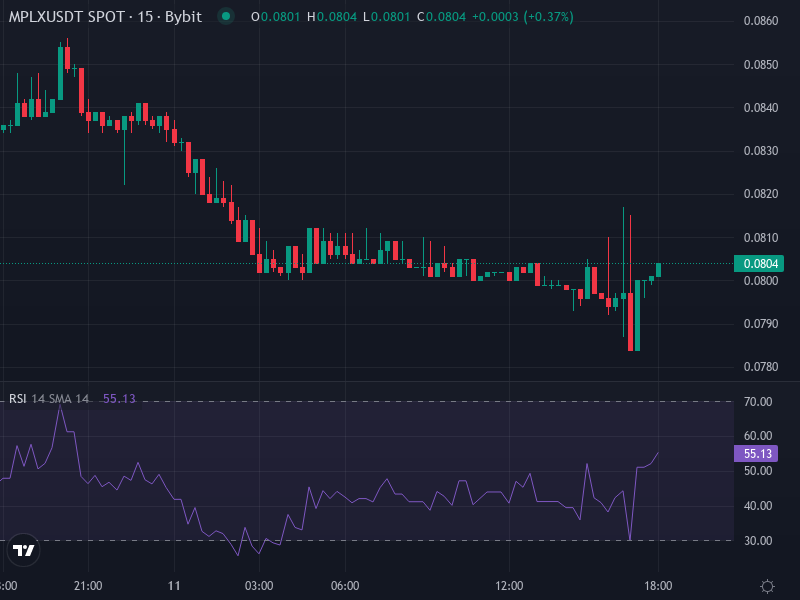
Support levels to watch are in the $0.075 to $0.078 range, which align with recent intraday lows and areas where volume has clustered. If those don’t hold, we could see a deeper drop toward $0.065 to $0.070. On the upside, the first real resistance sits around $0.095 to $0.100. Breaking through that would require a catalyst—maybe a surge in NFT minting activity or broader crypto market strength. Beyond that, $0.120 is the next hurdle if momentum really picks up.
Reading the Technical Tea Leaves
The RSI is close to oversold levels but hasn’t crossed below 30 yet, which would typically signal an imminent bounce. Until that happens—or until it starts trending back up—caution is warranted. The MACD tells a similar story: the MACD line is still below the signal line, and there’s no indication of an upward crossover. Volume has been patchy too. We’ve seen spikes around announcements and liquidity campaigns, but day-to-day trading volume hasn’t been strong enough to confirm any breakout attempts above resistance.
What Could Happen Next
Looking ahead over the next four to eight weeks, there are a few realistic scenarios worth considering. In a bullish case, we’d need a clear catalyst—maybe a spike in token launches using Genesis, strong NFT minting demand, or a broader crypto market rally. If MPLX can push above $0.100 with volume backing it up and a MACD crossover, the next targets would be $0.120 and potentially $0.135. That’s the optimistic path, but it hinges on several things going right at once.
A more likely near-term outcome might be neutral consolidation. MPLX could just chop sideways between $0.075 and $0.095, with buyers and sellers locked in a standoff. Moving averages would flatten out, RSI would bounce around the 40-50 range, and we’d essentially be waiting for the next big narrative to break the range one way or the other.
Then there’s the bearish risk. If support between $0.075 and $0.078 gives way, we’re probably heading down to $0.065 to $0.070. That could happen if minting activity slows, if the layoffs trigger more concern, or if the broader crypto market hits turbulence. A break below $0.060 would be a serious problem and likely trigger a wave of stop-losses and selling pressure.
Taking a Longer View
If you’re thinking about 2026 and 2027, the outlook depends heavily on execution. Assuming Metaplex keeps up the buyback program, continues growing ecosystem usage—especially through token launches, gaming integrations, and NFT tooling—and the crypto market enters a recovery phase, there’s a reasonable case for MPLX moving toward $0.150 to $0.200 over the next 12 to 18 months. That’s not a guarantee, but the pieces are there if things line up.
On the flip side, if demand doesn’t pick up, if the protocol stagnates, or if macro headwinds intensify, MPLX could stay stuck below $0.050 or drift even lower. The layoffs are a red flag worth monitoring. If they signal deeper trouble rather than prudent cost management, sentiment could sour quickly.
Bottom line: MPLX is at a crossroads. The fundamentals show promise—buybacks, ecosystem growth, exchange listings—but the technical picture is shaky and the recent news isn’t all positive. The next few weeks will likely determine whether this is a buying opportunity or a signal to stay cautious.