
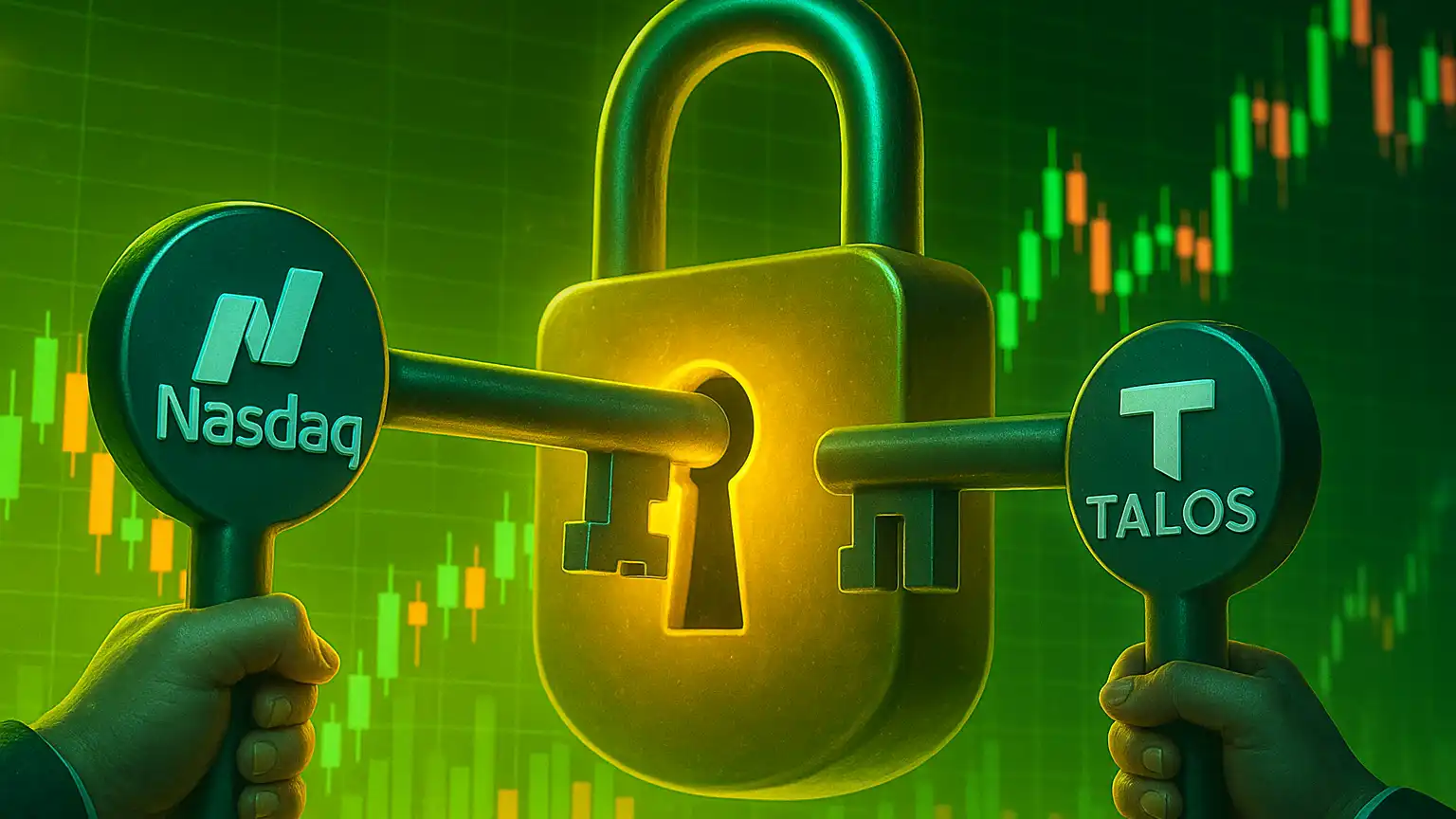
Nasdaq isn’t just dipping its toes into crypto infrastructure anymore—it’s jumping in with both feet.
The exchange giant announced this week that it’s plugging its Calypso risk management system and Trade Surveillance tools directly into Talos, a platform that institutional traders use to access digital asset markets.
This isn’t another pilot program or proof-of-concept demo. It’s a live integration that banks, hedge funds, and prime brokers can start using immediately.
The goal? Free up an estimated $35 billion in collateral that’s currently sitting idle because of outdated settlement processes and redundant safety buffers.
By connecting Nasdaq’s back-office muscle with Talos’s execution platform, the partnership promises real-time movement of traditional securities and tokenized assets through a single system.
Why $35 Billion Is Just Sitting There
In traditional finance, money has to wait. When you buy or sell stocks or Treasury bonds, settlement takes about a day. During that window, firms have to keep extra cash on hand—just in case.
Now add crypto trading to the mix. Digital asset markets run around the clock, and price swings can be brutal. So firms need even more cash sitting in margin accounts to cover potential losses.
The problem? These two safety cushions overlap. A trading desk operating in both worlds ends up parking billions in what Nasdaq calls “corrective and non-interest-bearing measures”—money that could be working but isn’t.
Nasdaq estimates that globally, about $35 billion is locked up this way.
The Nasdaq-Talos integration tackles this waste in three ways:
Smarter risk tracking. Calypso constantly recalculates how much margin a firm actually needs across all its positions—stocks, bonds, crypto, everything. That means fewer duplicate buffers.
Instant settlement. Tokenized Treasuries or other collateral can be moved in seconds instead of waiting a full business day. No more dead time, no more idle cash.
Real-time surveillance. Nasdaq’s monitoring tools watch for market manipulation like wash trading or spoofing. When compliance teams trust the data, they’re more comfortable shrinking those safety cushions.
What This Looks Like in Practice
Picture a hedge fund that’s long U.S. Treasury notes and short Bitcoin futures. Bitcoin suddenly rallies, triggering a margin call on the short position.
Normally, the fund would have to wire more cash or sell part of its Treasury position—both of which take time and disrupt the strategy.
With the new setup, the fund can tokenize a portion of its Treasuries, pledge them instantly through Calypso, and meet the margin call in seconds. The surveillance system confirms everything’s legitimate, and the fund’s idle cash buffer shrinks to almost nothing.
Capital that used to be frozen for a day is back in play before the next trade.
What This Means for the Bigger Picture
This partnership puts Nasdaq and Talos right in the middle of a high-stakes competition to control how tokenized assets move through the financial system.
Other players—big banks and custodians—have been running small, closed experiments. Nasdaq is doing the opposite: taking a proven system from traditional finance and dropping it straight into the crypto world.
For institutional investors, the choice becomes clear. Platforms that offer instant collateral movement and serious oversight will attract regulated money. Platforms that don’t will start to look like unregulated backwaters, suitable only for retail speculators or firms hunting for regulatory loopholes.
That $35 billion efficiency gain is just the opening act. What really matters is the direction this points: toward a financial system where liquidity flows freely between asset classes, time zones, and market structures.
While the headlines chase meme coins and day-trading drama, the real story is playing out in the infrastructure layer. Whoever controls how collateral moves—quickly, safely, and across markets—will set the rules for global finance in the years ahead.