
The Rise of Tokenized Equities and NVIDIA’s Position
Tokenized stocks have exploded in popularity over the past year, with NVIDIA’s xStock (NVDAX) riding this wave. By early 2026, tokenized equities hit nearly $1 billion in on-chain value—a staggering 2,900% jump year-over-year. Companies like Backed Finance and Ondo Finance are driving this growth, benefiting from clearer regulations and growing interest in Real World Assets from both traditional finance and DeFi circles.
What makes NVDAX appealing is simple: you can trade it 24/7, buy fractional shares of NVIDIA equity, and access it through crypto wallets. Institutional money is starting to pay attention too, which creates a solid foundation for continued growth. The tokenization trend isn’t slowing down—it’s becoming a legitimate bridge between traditional stock markets and blockchain infrastructure.
Current Technical Picture and Price Action
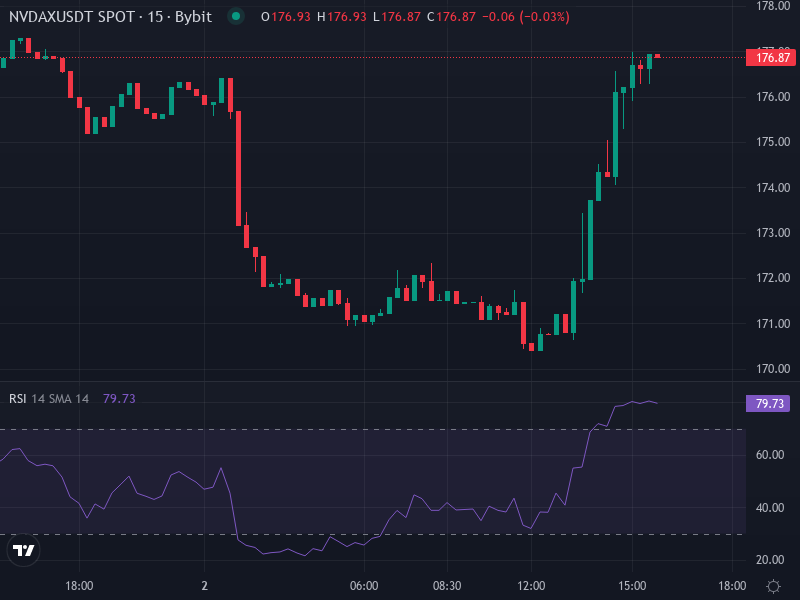
Right now, NVDAX is trading around $176.73 USDT, barely changed over the last 24 hours (down about 0.003%). That suggests the market is in a wait-and-see mode. The daily range has been between $183.44 on the low end and $187.34 on the high end, putting the current price toward the bottom of that band. The all-time high near $211.55 is still a good distance away and likely represents strong resistance if we get a rally.
Looking at the technical indicators, things are mixed. The price sits below both the 50-day moving average (around $184.20) and the 200-day moving average (roughly $178.80). The RSI—a momentum gauge—hovers in the 30s to low 40s, showing weak momentum but not quite oversold territory yet. Meanwhile, the MACD indicator remains negative and below its signal line, pointing to continued bearish pressure unless something shifts soon.
Key Support and Resistance Zones
On the downside, the $172 to $175 area looks like solid support, with $175 acting as a psychological floor. If that breaks, the next major zone to watch is the all-time low around $150.17, though that’s a ways off.
On the upside, immediate resistance sits between $184 and $190. That’s where previous selling pressure kicked in, and it lines up with those moving averages mentioned earlier. If NVDAX can push through that zone with real volume, then the path opens up toward retesting the $211 peak.
Price Forecast and What to Watch
Based on current technicals and market sentiment, here’s how things could play out over the next few weeks to a couple of months:
Bullish case: If NVDAX climbs back above $180 and holds, especially with increasing volume, we could see a run toward $190 to $195. The key would be the MACD crossing upward and the RSI pushing above 50, signaling renewed momentum. A sustained break above $195 would open the door to testing that $211 high again.
Sideways grind: More likely in the near term, NVDAX might just consolidate between $172 and $180. Momentum indicators would stay weak, and without a major catalyst—like a big move in NVIDIA’s actual stock or broader crypto strength—the token could just drift sideways or inch slightly lower toward $170.
Bearish scenario: If tech stocks take a hit or macro conditions worsen, and support at $172 to $175 fails, we could see a drop toward $160 to $165. In a worst-case scenario, the all-time low zone around $150 would come into focus as the floor.
Short-Term Signals for Traders
If you’re actively trading NVDAX, here’s what to keep an eye on:
First, watch for the MACD line crossing above its signal line, especially on the daily or four-hour charts. That would be the first sign of a momentum shift. Second, look for the RSI to break out of the 30-40 range and push toward 50 or higher—that would confirm buyers are stepping back in.
Third, pay attention to those moving averages. Reclaiming the 50-day MA would be a good first step; pushing above the 200-day MA would signal stronger conviction. And finally, volume is critical. Any rally needs expanding volume to sustain itself, especially when trying to break through resistance. Without it, any bounce is likely to fizzle out quickly.