

The Big Picture: Progress vs. Pressure
Oasis Network is caught between two opposing forces right now. On one hand, the project is making real technical progress—especially around privacy infrastructure and enterprise partnerships. On the other, regulatory headwinds are creating near-term uncertainty that’s weighing on price.
Let’s start with the bad news. Three major South Korean exchanges—Upbit, Bithumb, and Coinone—announced they’ll be delisting Oasis (OAS) on March 13, 2026, citing transparency concerns. That’s a meaningful blow to regional liquidity and sentiment, and it’s likely contributing to the recent sell-off.
But the project isn’t sitting still. Oasis has been quietly building out its ROFL (Runtime Offchain Logic) framework, which is designed to support confidential computing for AI and institutional use cases. The network has also attracted serious names like Franklin Templeton and Zodia Custody, signaling that institutional players see real value in what Oasis is trying to build. Add in ongoing work on bridges, better user experience, and real-world asset deployment, and you’ve got a foundation that could pay off—if the team executes.
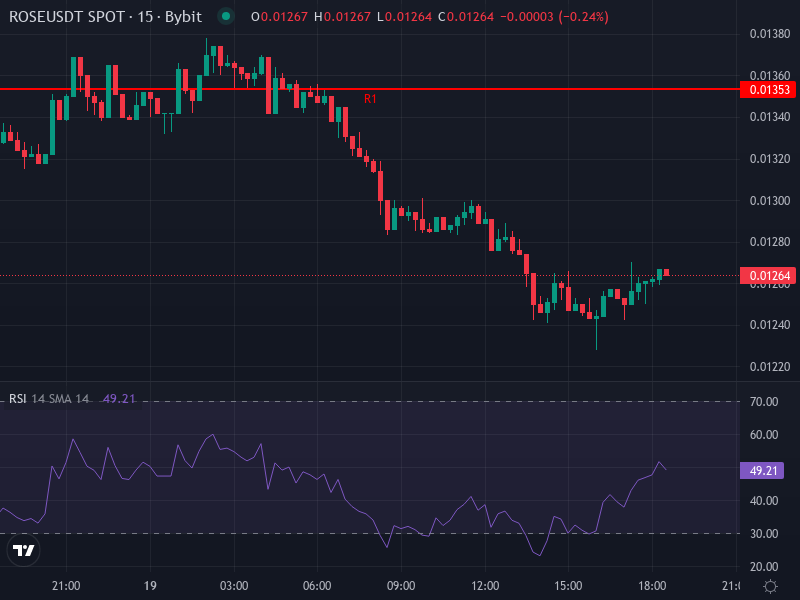
Right now, ROSE is trading around $0.012615, down roughly 5.16% in the last 24 hours. That’s not panic-selling territory, but it does reflect the tension between short-term fear and longer-term potential.
What the Technicals Are Saying
If you pull up a 4-hour chart for ROSE/USDT, the picture isn’t exactly bullish—but it’s not a total breakdown either. Here’s what the key indicators are showing:
RSI is sitting around 45.68. That’s neutral ground. The token isn’t oversold, but it’s not overbought either. Basically, momentum is flat, and traders are waiting for a clearer signal before committing.
The MACD is negative, with the MACD line sitting below the signal line and the histogram in red. Translation: downward pressure is still in control, and momentum hasn’t shifted yet.
Moving averages are acting as resistance. The 4-hour SMA is around $0.012838, and the EMA is near $0.012949. Since ROSE is trading below both, those levels are now short-term ceilings. If the price can’t reclaim them, it’s hard to get excited about a rally.
Pivot points give us a roadmap. The nearest resistance sits at about $0.013533, with the pivot point around $0.012907. On the downside, support is at roughly $0.012023. If that pivot breaks, expect a test of S1.
What Happens Next? A Few Scenarios
Short term (1–2 weeks): Unless something shifts quickly, ROSE is probably headed toward the $0.0120–$0.0121 support zone. If it bounces there, bulls would need to reclaim the EMA around $0.01295 and then push through resistance near $0.0135. If that support doesn’t hold, though, things could get messier. A breakdown could open the door to $0.0114 or even $0.0110, especially if the Korean delisting news continues to weigh on sentiment.
Medium term (1–3 months): If the regulatory dust settles and Oasis starts delivering on its tech roadmap—think ROFL bridge activation, institutional adoption picking up steam—there’s room for a recovery back toward the $0.020–$0.025 range. That would require a shift in the broader altcoin market, too. But if negative sentiment deepens and key support levels break, we could see ROSE drift down toward $0.0085–$0.0090, where thinner volume might slow the bleed but also make it harder to rally quickly.
What to Watch Going Forward
A few key factors will determine which path ROSE takes from here:
More regulatory trouble in Asia. If other exchanges follow suit or if regulators ramp up scrutiny, liquidity and sentiment could take another hit. This is the biggest near-term risk.
ROFL adoption and real-world traction. Pilots with AI projects, progress on trustless bridges, and usability improvements on Sapphire EVM will matter more than any short-term price pump. If Oasis can show real adoption, the narrative changes.
Macro and risk appetite. If the broader crypto market turns risk-off—say, due to economic uncertainty or a Bitcoin correction—low-cap, privacy-focused tokens like ROSE tend to get hit harder. Keep an eye on the macro backdrop.
Key technical levels. Resistance around $0.0135–$0.0140 and support near $0.0120–$0.0110 are the lines in the sand. A break in either direction will likely set the tone for the next leg.
Bottom line: ROSE is under pressure right now, trading below its short-term moving averages and facing regulatory headwinds. But the fundamentals—privacy tech, AI infrastructure, institutional partnerships—are still intact. If the team delivers and sentiment improves, there’s upside. Until then, it’s a wait-and-see game.