
Where Flux Stands Right Now
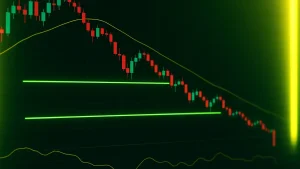
Flux is currently trading at about $0.10110, down roughly 9% in the last 24 hours. The charts aren’t painting a pretty picture at the moment. When you look at the 4-hour timeframe, the technical indicators are flashing warning signs across the board.
The RSI—which measures whether something’s overbought or oversold—is sitting around 30.54. That’s deep in oversold territory, meaning the price has fallen hard and fast. Sometimes when things get this beat up, you’ll see a bounce. But there’s more to the story.
The MACD, another momentum indicator, shows the trend line sitting below its signal line. The histogram is negative too. Translation? Sellers are still in control, and the downward pressure hasn’t let up yet.
Both the simple and exponential moving averages—around $0.1115 and $0.1099 respectively—are now acting as ceilings overhead. The price is trading well below them, which means any rally will likely hit resistance before it gets very far.
Support levels to watch are around $0.1007 (the daily pivot), then $0.0991 and $0.0968 if things slide further. On the upside, resistance sits at $0.1030, $0.1046, and beyond that, the moving average cluster near $0.11.
On the fundamental side, Flux recently completed a major upgrade—transitioning to Proof of Useful Work v2. This shifts the network away from traditional mining toward a node-based system designed to reward people running infrastructure. It’s a solid technical achievement and positions Flux for more sustainable growth. But here’s the thing: the market hasn’t gotten excited about it yet. Upgrades take time to show real-world adoption, and right now, investors seem to be waiting for proof that this new system will actually drive usage and value.
What the Charts Are Telling Us
Right now, the technical setup leans bearish. The price is below key moving averages, momentum indicators point down, and there’s been consistent selling pressure. But the RSI being near oversold levels does suggest we could see a short-term bounce—especially if support around $0.0991 holds firm.
If that support fails, we’re likely heading toward $0.0968 or even $0.0952. The MACD hasn’t crossed back yet, so any upward move will probably feel more like a relief rally than a true reversal. To change the narrative, Flux would need to break back above that $0.1099 to $0.1115 zone and hold it. That would signal the bears are losing grip.
Three Possible Paths Forward
If the selling continues: We could see Flux drop below the pivot at $0.1007 and drift toward $0.0991, then $0.0968. If macro conditions stay weak or if crypto broadly stays in the red, a move down to $0.085 or even $0.090 isn’t out of the question.
Most likely scenario: Flux trades sideways between $0.095 and $0.110 for a while. We might see brief bounces from support, maybe touching $0.110 again, but nothing that sticks. The RSI would flatten out, and volume would dry up as traders wait for a clearer signal.
If momentum flips: For a bullish case to play out, Flux needs to reclaim and hold above the moving averages near $0.11. From there, breaking through resistance at $0.1030 and $0.1046 would open the door to $0.120 or even $0.125. But this would require either big news, strong adoption metrics, or a broader crypto rally to provide the fuel.
Looking Ahead: Months and Beyond
The longer-term picture is murkier. Various forecast models show a wide range of outcomes for Flux through 2025. Some optimistic projections see the token reaching $0.16 to $0.20 by year-end if things go well—if node operator activity picks up, if the new consensus mechanism proves itself, if demand for decentralized cloud services grows.
On the flip side, more conservative or bearish models warn that Flux could fall back into the $0.06 to $0.10 range if adoption stalls, liquidity dries up, or the broader crypto market takes another leg down. In bull-case scenarios, we’re talking about potential gains of 30% to 80% from here, but those numbers assume everything goes right.
What really matters over the next few months is whether Flux can show real traction. Are developers building on it? Are node operators growing? Is network usage increasing? Without those fundamentals improving, price action will stay speculative and choppy.
Other wildcards include regulatory developments around decentralized infrastructure, the broader macro environment (interest rates, risk appetite), and how well the Flux team executes on partnerships or integrations.
Realistic Price Targets
For the next few weeks, a reasonable range is $0.095 to $0.110, with possible upside to $0.120 if resistance breaks cleanly. A drop below $0.095 would likely lead to a test of $0.085 to $0.090.
Over the next three to six months, if conditions improve and sentiment shifts, Flux could work its way toward $0.150 to $0.180. But if bearish forces dominate or the project fails to gain adoption traction, revisiting the $0.060 to $0.080 zone is entirely possible.
For anyone thinking about entering a position, caution is warranted. Watch those support levels closely. Wait for confirmation that momentum is actually turning before jumping in. Set stop losses. In markets like this, patience and discipline matter more than trying to catch a falling knife.