

What’s Been Happening With Telcoin
Telcoin (TEL) has been making some interesting moves behind the scenes over the past few months, even if the price action hasn’t exactly been thrilling. The team put forward their Year-3 Treasury Allocation Proposal for 2026, setting aside 900 million TEL tokens for things that actually matter—platform infrastructure, validator rewards, security audits, and ecosystem expansion ahead of their mainnet launch. This isn’t just more vague “development” talk. They’re shifting gears from building to actually launching something real.
Then there’s the Nebraska banking charter, which might sound boring but is actually a pretty big deal. It allows Telcoin to issue regulated stablecoins and operate as a proper depository institution. That’s the kind of regulatory foundation that could turn TEL from just another speculative altcoin into something with actual utility and compliance backing. The building blocks are there for partnerships, integrations, and legitimate network use.
Despite all that, the price isn’t exactly celebrating. TEL/USDT is currently sitting around $0.00210733, down about 3.44% in the last 24 hours. The market’s just not feeling it right now. Liquidity is thin, which means even small trades can push the price around more than they should. Looking at the technical indicators and short-term forecasts, there’s more bearish pressure than bullish momentum unless something changes fast.
What the Charts Are Telling Us
If you zoom into the hourly and daily charts, TEL is trading below most of its key moving averages—the EMA 20, 50, and 100, plus the SMA 50 and 100. Each of those lines has been acting like a ceiling, pushing the price back down when it tries to climb. The Relative Strength Index is hovering in the mid-30s to low-40s, which shows weak momentum but doesn’t scream “oversold” either. The MACD isn’t giving any clear reversal signals, just neutral to slightly negative readings. Volatility has also tightened up, with the Average True Range showing a compressed trading range. Translation: sellers are in control, and buyers aren’t stepping up yet.
Looking at support and resistance, a few key levels keep showing up across different technical analysis sources:
- Support zones: There’s weak support around $0.00244 and $0.00240, with a more meaningful level sitting near $0.00213. If TEL drops below $0.00210, things could get messy quickly, potentially sliding down toward that $0.00213 support or lower.
- Resistance zones: The first real barrier is between $0.00255 and $0.00266, and that’s considered pretty strong. Above that, you’re looking at $0.00267 to $0.00274 in the short term. Beyond that, resistance weakens—but only if volume actually shows up.
Short-Term Price Predictions
Various prediction models from sources like CandleRank and CoinCodex are pointing to minimal gains over the next few days if TEL can hold its current support. CandleRank suggests a possible 1-2% bounce over the next week, maybe pushing toward $0.00255 to $0.00260—assuming Bitcoin doesn’t tank and there’s no major bad news.
Longer-term outlooks are cautious. Both the 50-day and 200-day moving averages are sitting below $0.00300, which lines up with those resistance zones we mentioned. Without a real shift in the broader crypto market—more altcoin interest, regulatory clarity, actual demand—the path of least resistance is probably still downward unless buyers suddenly wake up.
What Could Happen Next
Let’s talk about two realistic scenarios based on where things stand right now.
The bearish case: If TEL can’t hold above that $0.00213 to $0.00220 range, there’s a real risk it drops back toward its yearly lows between $0.0018 and $0.0020. Declining volume, failed support levels, or a broader crypto market pullback (especially if Bitcoin stumbles) would make things worse. In that scenario, resistance around $0.00255 to $0.00270 stays firmly in place, and there’s no reason to expect a breakout without a strong catalyst.
The recovery case: For a real reversal, TEL needs to break above $0.00255 with solid volume backing it up. You’d want to see the MACD cross over positively, RSI climbing above 50, and those moving averages flipping from resistance to support. If that happens, TEL could push toward $0.00280 to $0.00310 over the next few weeks. Beyond that, there’s more significant resistance around $0.00430 to $0.00460 where previous trend highs sit. Getting there would require the whole altcoin market to heat up again.
Catalysts and Risks Worth Watching
On the positive side, there are some real catalysts on the horizon. The Telcoin Network mainnet is scheduled to launch in the first half of 2026, and they’re planning to roll out regional stablecoins (Digital Cash) along with further regulatory approvals tied to that banking charter. Any of these could bring renewed attention and investment. The treasury-funded initiatives under the TELIP framework—especially stuff aimed at exchange listings, validator support, and telecom partnerships—could drive upside if executed well.
But the risks are just as real. Low liquidity makes downside moves sharper and faster. TEL still lacks major exchange listings or diverse trading pairs, which keeps it vulnerable to sudden market shocks. Add in macro risks like regulatory crackdowns, global financial stress, or a general crypto market downturn, and even the best technical setups can fall apart quickly.
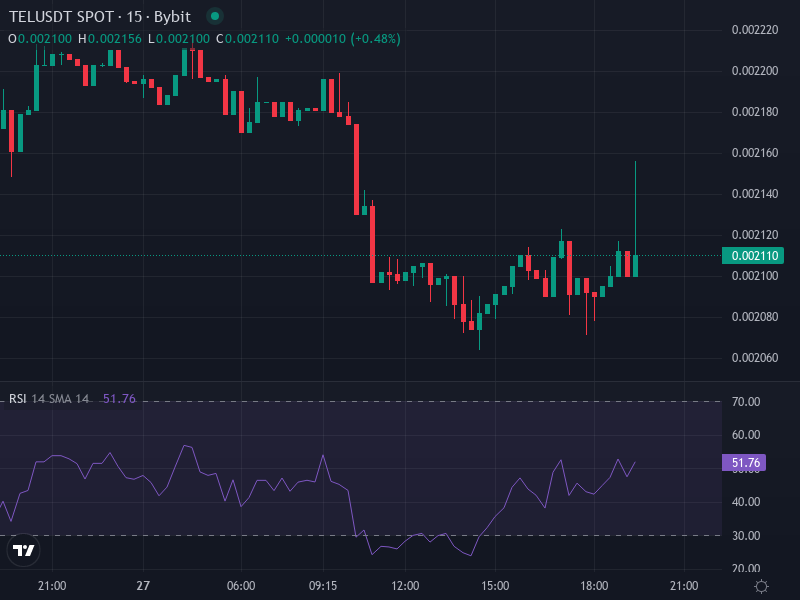
So where does that leave us? If support around $0.00210 to $0.00213 holds, there’s a decent chance of a modest bounce toward $0.00250 to $0.00265 over the next week or so. If that support breaks, we could see TEL slip back toward $0.00180 to $0.00200. Over the next month or two, if the news stays positive and the network keeps growing, maybe we test resistance around $0.00310. But anything beyond that—like $0.0040 or higher—seems unlikely without a major catalyst or a broader altcoin rally.