Why Kyiv Pulled the Plug During Wartime
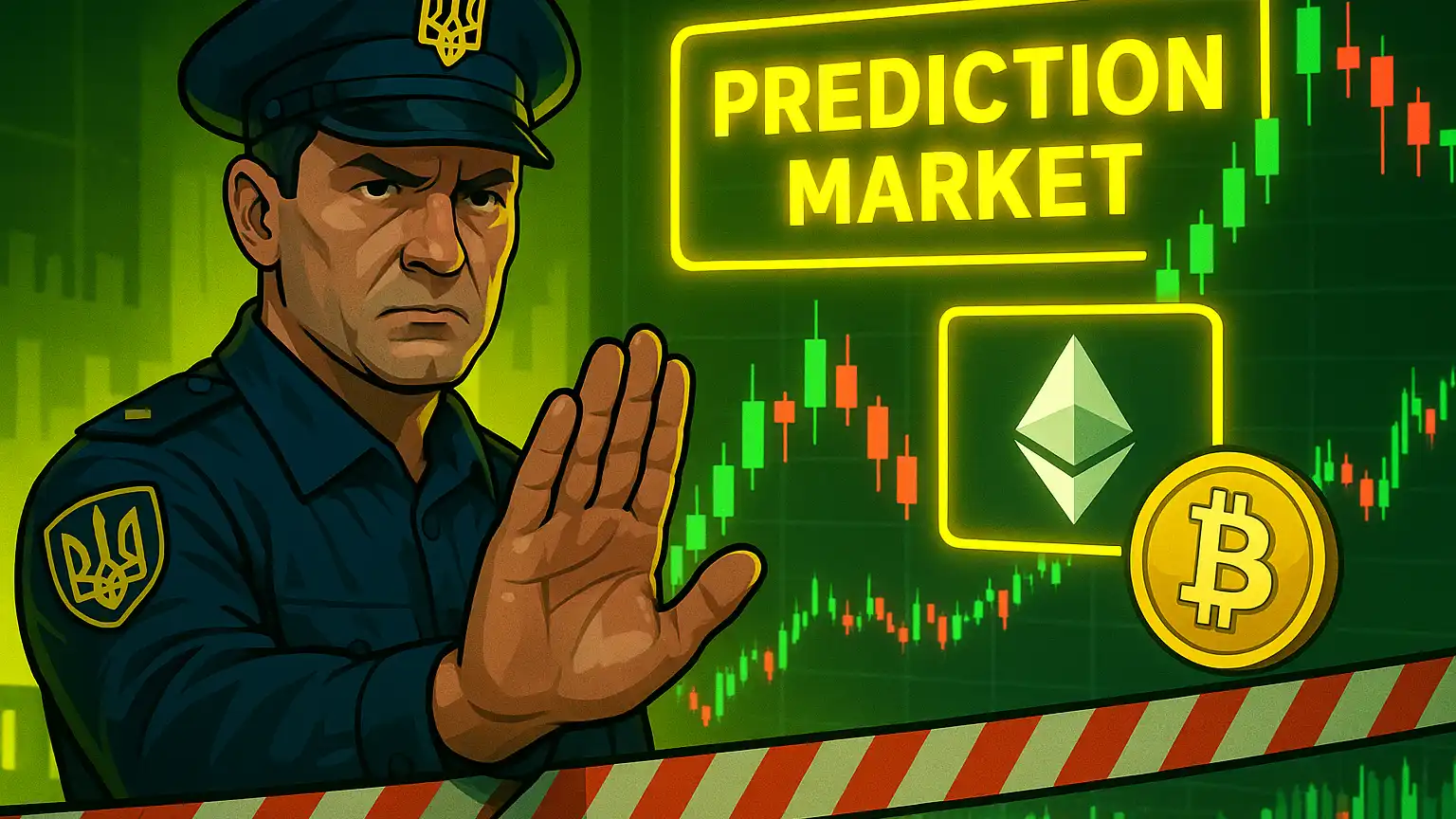
Nearly two years into Russia’s full-scale invasion, Ukraine’s telecom regulator has banned Polymarket.com.
The National Commission for the Regulation of Electronic Communications added the site to its blacklist on
December 10, 2025, under Resolution No. 695. The order requires all Ukrainian internet providers to block
access to any platform that “organizes, conducts, or facilitates gambling” without a local license.
Officials say the real issue is letting citizens place bets on battlefield outcomes or ceasefire probabilities.
In their eyes, allowing people to speculate on matters of national survival crosses a red line—especially when
the platform operates without Ukrainian approval. Polymarket calls itself a “decentralized information market,”
but its core product looks a lot like gambling to regulators. Users buy tokenized shares that pay out either
one USDC or zero depending on whether an event happens. When Ukrainians try to visit the site now, they see a
government warning page. Wallets detected inside Ukraine can withdraw funds but can’t place new trades.
Supporters point out that Polymarket runs on USDC and the Polygon blockchain, giving it more transparency than
state lotteries or offshore sportsbooks. But that transparency doesn’t help when the optics are terrible—imagine
citizens betting on whether their own cities will fall to occupation. Ukrainian officials also argue that any
market built on real-world events functions like a sportsbook if the operator just collects fees without taking
counter-party risk. That argument is catching on far beyond Eastern Europe.
A Global Wave of Enforcement
Ukraine isn’t alone. On January 9, 2026, Tennessee’s Sports Wagering Council sent cease-and-desist letters to
Polymarket, Kalshi, and Crypto.com, accusing them of running unlicensed sports betting despite claiming federal
exemptions from the Commodity Futures Trading Commission. Around the same time, U.S. Representative Ritchie Torres
previewed legislation that would ban public officials from trading on prediction markets after news broke that a
congressional staffer held a six-figure position betting on regime change in Venezuela.
Europe is moving just as fast. France’s gaming authority is revisiting its rules on event wagering. Germany is
circulating a consultation paper that would treat decentralized prediction pools as derivatives contracts, pulling
them under securities law. Even Malta—once known as “Blockchain Island”—has warned local crypto exchanges not to
list event-based markets without explicit approval from its Gaming Authority. In Asia-Pacific, Singapore and
Australia have already forced Polymarket into view-only mode, letting users withdraw but blocking new bets.
All told, Polymarket is now geoblocked—fully or partially—in at least 33 countries. That number has nearly
doubled since late 2024, and it keeps climbing.
What Comes Next for Prediction Markets
The Licensing Puzzle
Polymarket spent $112 million to acquire QCX LLC, which gave it a designated contract market license in the
United States. But that federal license doesn’t solve the state-level problem. Every state has its own
sports-wagering rules, and most don’t recognize prediction markets as a separate category. Industry lobbyists
are quietly pushing for a federal “predictions sandbox” that would override conflicting state laws, but that
effort faces headwinds from the Torres bill and mounting election-year scrutiny.
Creative Workarounds and New Risks
Some rival platforms are experimenting with “information markets” where tokens automatically burn to signal
consensus instead of paying out cash. The hope is that removing the payout removes the gambling label.
Regulators haven’t weighed in yet on whether they’ll see through that design choice.
Anti-money-laundering pressure is also building. On-chain markets tied to geopolitics raise red flags for
compliance teams, especially as sanctioned countries look for liquidity routes. Ukraine’s block notice
explicitly mentions money-laundering concerns alongside gambling. Future enforcement may come less from
gaming boards and more from financial-crime units hunting illicit flows.
Market Sentiment and Valuation
Despite the regulatory storm, secondary markets still value Polymarket’s parent company at around $8 billion,
based on recent private-equity bids. But liquidity for longer-dated contracts has dried up since December.
Traders appear to be demanding a risk premium for regulatory uncertainty, and institutional money is sitting
on the sidelines until the legal picture clears.
Ukraine’s decisive move underscores a simple reality: when prediction markets collide with live-fire geopolitics,
sovereignty beats decentralization every time. Whether innovators can engineer around that tension—or regulators
can craft licensing regimes that balance free-market forecasting with public-policy guardrails—will define the
next chapter of crypto’s most controversial frontier.