Where Things Stand Now
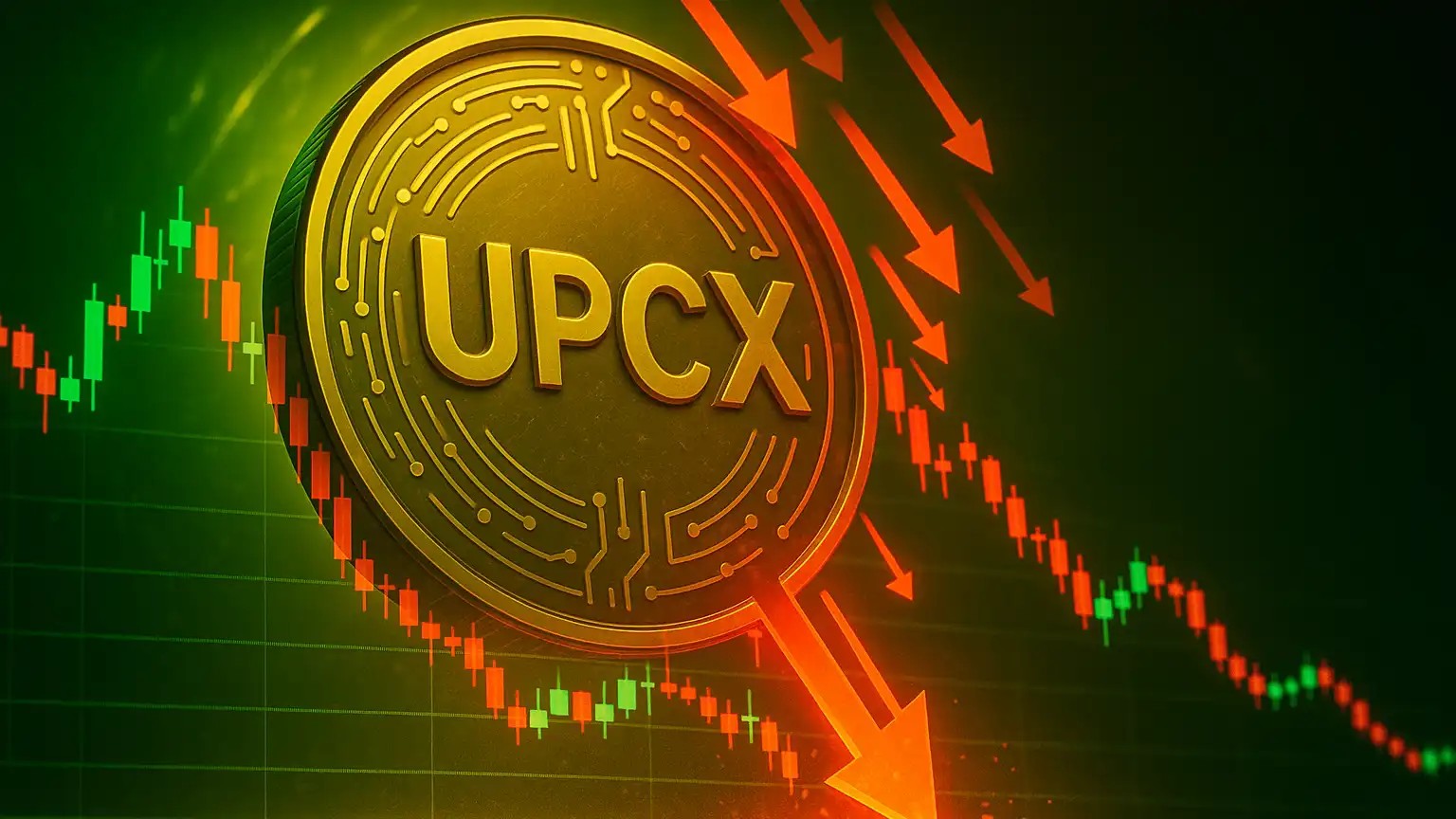
UPCX is trading around $0.50 right now, which represents a brutal decline of more than 90% from its peak of roughly $5.37 back in March 2025. With about 100 million tokens in circulation out of a total supply of 780 million, the project’s market cap hovers around $50 million—a far cry from where it stood just a few months ago.
The mood around UPCX is pretty grim. Market sentiment indicators show fear is running high, with the Fear & Greed Index sitting at a depressed 26. Year-over-year returns are deep in the red, and most platform-based technical signals are flashing bearish warnings across the board.
Adding to investor anxiety is the lingering memory of a $70 million exploit from April 2025 that involved compromised administrative wallet controls. While the team has reportedly conducted internal security audits since then, that breach continues to weigh heavily on confidence. Trust, once broken, doesn’t come back easily in crypto.
What the Charts Are Saying
Technically speaking, UPCX looks rough. Every major moving average—from the short-term 5-day and 10-day lines all the way out to the 50-day, 100-day, and 200-day averages—is signaling “sell.” The price is trading below all of them, which tells you there’s no real momentum pushing it higher right now.
The oversold indicators are screaming, though. The Relative Strength Index (RSI) has dropped near or below 20, Williams %R is buried in negative territory, and the Stochastic oscillators are showing similar extremes. Normally, these conditions hint at a potential bounce, but without strong buying volume or a clear catalyst, any relief rally could be short-lived.
Support is shaky. The recent low around $0.494 marks the current floor, but if that breaks, the next stop could be down near $0.45 or even lower. On the upside, resistance clusters around $0.55 to $0.60, with the 50-day moving average acting as a ceiling near $0.54. Getting back above $0.60 would require a real shift in sentiment and volume.
Levels Worth Watching
- Support: $0.494 is the line in the sand right now. Break that, and $0.45 becomes the next target—maybe even $0.35 if things get ugly.
- Resistance: $0.55–$0.60 is where sellers are likely waiting. Beyond that, $0.70 represents a bigger hurdle from earlier price action.
- Moving averages: The 50-day and 100-day averages around $0.54–$0.58 will act as speed bumps for any recovery attempt.
What Happens Next
Most likely scenario: UPCX probably stays stuck between $0.45 and $0.55 in the near term. The technicals are oversold, but there’s no clear reason for buyers to jump in aggressively. If $0.45 gives way, we could see a quick drop toward $0.35–$0.40, especially if the broader crypto market hits turbulence.
If things improve: A positive development—maybe a credible third-party security audit, a major partnership, or a broader market rally—could spark a bounce. Breaking through $0.55–$0.60 would open the door to $0.70–$0.80. But getting past the 200-day moving average around $0.60 will take real conviction and volume, not just hopium.
Worst case: If security concerns flare up again or regulatory pressure intensifies, UPCX could sink much further. A move toward $0.30 or lower isn’t unthinkable if panic selling kicks in or if the overall crypto market takes a beating.
Thinking About Risk and Opportunity
For short-term traders, there might be a play near current support around $0.49–$0.50, but you’d want tight stop-losses just below that level. The downside risk is real. Wait for confirmation before jumping in—something like bullish divergence on the MACD, a clear break above $0.55, or a spike in trading volume and social buzz.
If you’re holding for the long haul, focus less on the daily chart and more on the fundamentals. Has the team truly addressed the security issues? Are there real-world use cases gaining traction in payments or programmable finance? What’s happening with token emissions and inflation? With supply already high and still growing, any sign that emissions are slowing or that utility is expanding could be a turning point. But without transparency and a clear path forward, regaining investor trust will be an uphill battle.