Where WAVES Stands Today
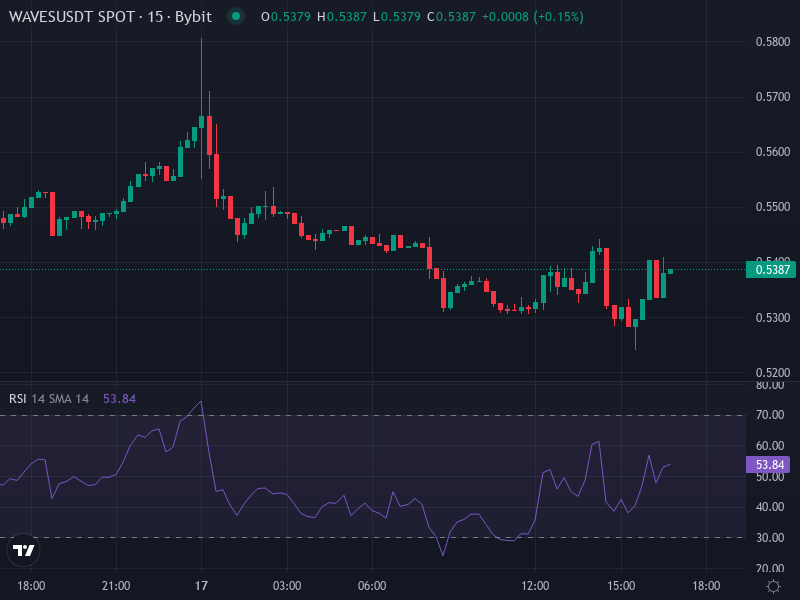
WAVES is currently trading around $0.5404 USDT, down roughly 0.74% in the past day. The project has been making headlines with plans for an Instant Finality mainnet launch in Q1 2026 and an expanding suite of AI-focused tools—think AI Launchpad and AI Liquidity Manager—designed to make life easier for developers and DeFi users. The promise of near-instant transactions (around 2 seconds) is certainly appealing in a crowded field of layer-1 blockchains. That said, market sentiment remains cautiously optimistic at best. There’s excitement around the tech upgrades, but execution risk and fierce competition from other platforms are real concerns that can’t be brushed aside.
Reading the Technical Signals
When you look at the 4-hour and daily charts, the picture isn’t particularly pretty right now. Several key indicators are flashing red:
- RSI sits at about 24.9—deep in oversold territory. This usually means sellers are exhausted, but it doesn’t guarantee a strong bounce is coming. Often it just means the downward momentum is slowing.
- MACD is negative, with the MACD line below the signal line and a histogram reading around -0.00394. This confirms bearish momentum is still in control.
- Moving averages are way above price—the simple moving average is near $1.169 and the exponential moving average around $1.160. When price is this far below its averages, it’s a clear sign of a strong downtrend.
- Daily pivot points paint a similar story. The main pivot sits at roughly $1.049, with resistance levels stacked at $1.098, $1.162, and $1.211. Support zones are down around $0.985, $0.936, and $0.872. With current price well below even the first resistance, the bearish structure is hard to miss.
What This All Means
Put simply, WAVES is deeply oversold in the short term but stuck in a broader downtrend. The combination of low RSI, negative MACD, and price sitting far below moving averages tells us that while a bounce is possible, it’s more likely to be a brief correction than the start of a new uptrend. There’s heavy resistance between $1.05 and $1.20, and without significant volume or positive news, it’s hard to see price breaking through. Any near-term rally should probably be viewed skeptically rather than as a sign the worst is over.
What Could Happen Next
Looking ahead over the next few weeks and months, here are the most likely scenarios based on current momentum and chart structure:
- If the selling continues, WAVES could test and potentially break support in the $0.50–$0.60 range. A slide toward $0.45–$0.50 seems entirely possible if we don’t see daily closes above $0.60. With the 4-hour chart showing weak bounces, this bearish path remains the base case for now.
- A modest bounce is possible given how oversold the RSI is. If buyers step in, we could see a move back toward the $0.70–$0.80 range. But don’t expect much more than that. Getting above $1.05–$1.20 would require serious buying volume and probably some major positive catalyst—something more than just hype.
- Over the longer term (3–6 months), a lot depends on whether the Instant Finality upgrade and AI tools actually gain traction. If WAVES can hold the $0.40–$0.50 zone, that could become a solid base for future growth. But to see a sustained move above $1.00, we’d need to see the weekly MACD flip positive, RSI climb back toward neutral (around 45–55), and price reclaim a major moving average like the 50-day EMA. That’s a tall order right now.
Risks Worth Watching
Beyond the charts, there are real-world risks that could weigh on WAVES. Competition is fierce—other blockchains are also integrating AI features, and developer attention is finite. Any delays or bugs in the mainnet launch or new tools could seriously dent confidence. Macro factors matter too: if interest rates stay elevated or broader risk appetite fades, speculative assets like WAVES tend to suffer. And finally, on-chain metrics will be telling. If total value locked (TVL) or usage numbers don’t improve even after the upgrades, the market will likely remain skeptical no matter how promising the technology sounds on paper.