The Big Changes Under Wormhole 2.0
Back in mid-September 2025, Wormhole rolled out what they’re calling “Wormhole 2.0″—a major refresh of how their native W token works. The team introduced something called the Wormhole Reserve, basically a treasury that collects revenue from both on-chain activity and off-chain sources. If you’re staking your W tokens and participating in governance, you’re now looking at a target yield of around 4%, which isn’t huge but gives holders some incentive to stick around.
Maybe the most interesting part? They scrapped those massive annual unlock cliffs that used to flood the market with tokens all at once. Now unlocks happen bi-weekly in smaller chunks. The goal here is pretty clear: smooth out the sell pressure and keep long-term holders from getting dumped on by sudden supply spikes. In theory, it should create a healthier market dynamic, though we’ll need time to see if it actually plays out that way.
Where Things Stand Right Now
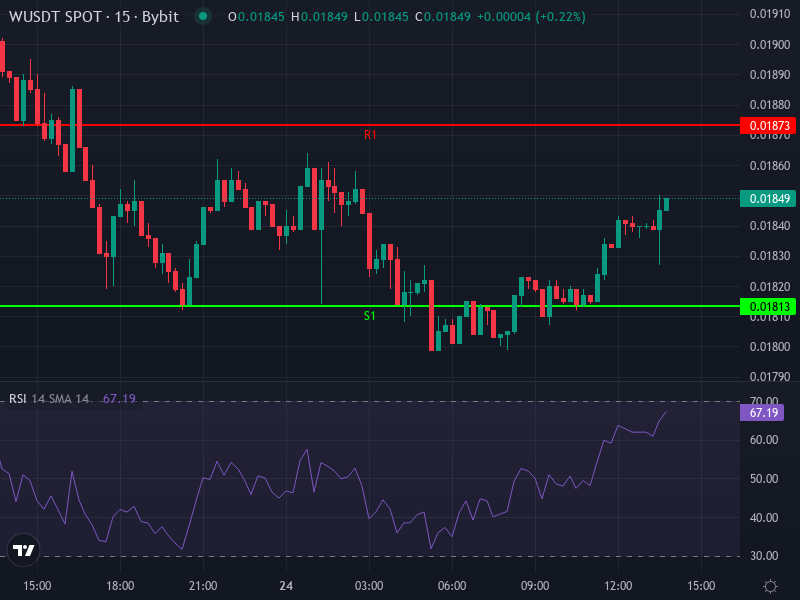
Unfortunately, good tokenomics can’t fight the tide alone. W has been struggling lately, sitting at around $0.01845 against USDT and down roughly 3% in the last day. The broader crypto market hasn’t been kind to altcoins, with risk-off sentiment dominating and institutional money flowing out. Bitcoin’s choppy performance hasn’t helped either—when BTC doesn’t provide a clear direction, smaller tokens like W tend to drift lower.
From a technical standpoint, the 4-hour chart shows an RSI of about 41.76. That’s bearish territory but not quite oversold yet, meaning there’s still room to fall before we hit levels where buyers typically step in. The MACD is sitting below its signal line with a negative histogram, which backs up the idea that momentum is pointing down in the short term.
Price is trading below both the 4-hour simple moving average (around $0.01921) and the exponential moving average (roughly $0.01906). Until W can climb back above those levels, upward moves are likely to meet resistance. On the daily chart, here’s what the key levels look like:
- Pivot point: $0.01837
- Resistance: R1 at $0.01873, R2 at $0.01897, R3 at $0.01933
- Support: S1 at $0.01813, S2 at $0.01777, S3 at $0.01753
These are the zones to watch—places where the price might bounce or break down depending on volume and sentiment.
Next Few Days: What Could Happen
If W manages to rally and push back above the $0.01906 EMA, the first real test will be at R1 around $0.01873. A strong move with volume could take it toward R2 ($0.01897) or even R3 ($0.01933), but don’t expect those levels to give up easily. Resistance zones tend to cap rallies unless there’s genuine buying pressure behind them.
On the downside, losing the daily pivot at $0.01837 would open the door to S1 ($0.01813), and if that doesn’t hold, we’re looking at S2 ($0.01777) or even S3 ($0.01753). The deeper we go, the more bearish the momentum indicators will look, which could trigger more selling from traders cutting losses.
Looking Further Out: Medium to Long-Term Picture
Over the next few months, the Wormhole 2.0 changes should start to show their effects—assuming protocol usage picks up and that reserve actually accumulates meaningful revenue. The 4% staking yield might attract some sticky capital, and the smoother unlock schedule should help prevent those violent sell-offs we’ve seen with other tokens.
That said, bi-weekly unlocks still mean fresh supply hitting the market regularly. Unless demand grows through increased bridge volumes, new partnerships, or broader adoption of Wormhole’s tools, that supply could keep a lid on price appreciation. Right now, if resistance around $0.019 to $0.020 holds firm, we’re probably looking at sideways consolidation for a while.
In a scenario where the broader market turns bullish—think Bitcoin finding its footing, risk-on sentiment returning, capital rotating back into altcoins—W could feasibly push toward $0.022 to $0.024 by late Q2 2026. But if macro conditions stay rough or crypto continues bleeding, a drop toward $0.015 to $0.016 wouldn’t be shocking, especially if that $0.0175 support level breaks.
Risks and Things to Keep an Eye On
On the risk side, there’s plenty to worry about. Macro headwinds like rising interest rates or fresh regulatory crackdowns could hit the whole sector. Competition in the cross-chain space is fierce—Wormhole isn’t the only game in town. And even with the improved unlock schedule, token supply pressure is still real, especially if staking uptake is slow.
For positive catalysts, watch for new integrations with major blockchain ecosystems, institutional adoption of Wormhole’s Native Token Transfers (NTT) and Portal Bridge, and any signs that protocol revenue is translating into real yield for stakers. If sentiment shifts and altcoins catch a bid again, W could surprise to the upside. Until then, it’s a waiting game.