Recent Developments and What’s Driving the Market
Wormhole has been quietly building out its infrastructure in some pretty interesting ways. The protocol recently integrated Ripple’s RLUSD stablecoin across multiple Layer-2 networks and set up cross-chain bridging between the XRP Ledger and BlackRock’s tokenized fund. That’s not small stuff—it positions Wormhole right at the intersection of institutional finance and cross-chain infrastructure, particularly as real-world asset tokenization gains traction.
On the technical side, the team hasn’t been sitting still either. They’ve rolled out zero-knowledge proofs for their Native Token Transfers system, deployed messaging infrastructure to high-performance EVM chains like Monad, and cleaned up their developer documentation. These aren’t flashy announcements, but they’re the kind of unsexy technical improvements that matter for long-term viability. For holders who’ve been waiting for signs of real progress, these moves offer at least some reassurance.
Where the Price Stands Right Now
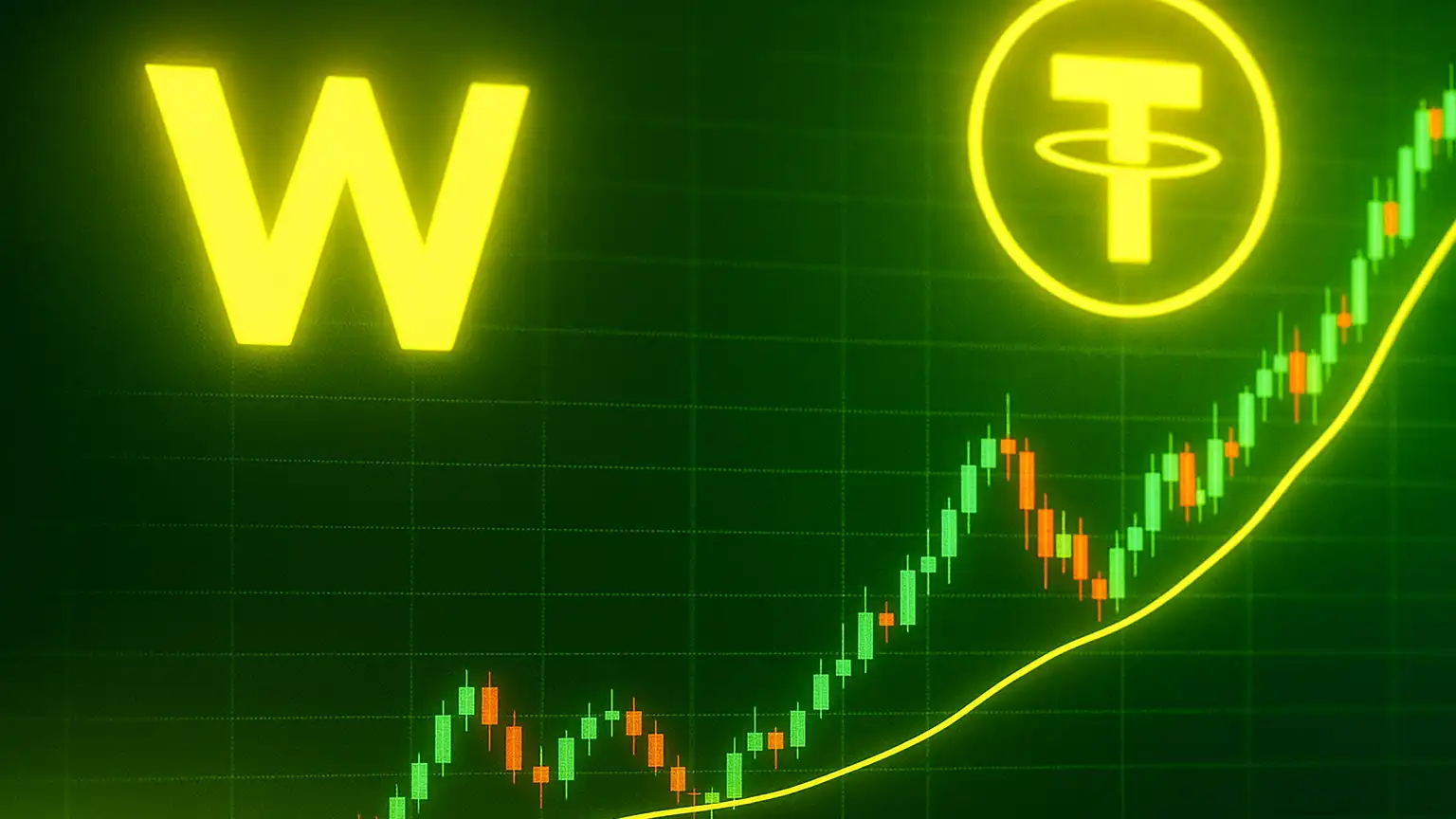
W/USDT is currently trading around $0.03439, up about 7.9% on the day. That sounds encouraging, but the technical picture is decidedly mixed. The 4-hour RSI sits near 49.2—basically neutral territory. The MACD is showing a slight bearish tilt with a marginally negative histogram, suggesting momentum hasn’t really picked a direction yet. The 4-hour Simple Moving Average is hovering at $0.03471 and the Exponential Moving Average at $0.03454, both just above current price. That means bulls need to clear those levels before getting too excited.
Looking at the daily pivot structure, resistance levels are stacking up at $0.03497, $0.03553, and $0.03657. Support sits at $0.03337, $0.03233, and $0.03177. The key resistance to watch is around $0.0358—the 23.6% Fibonacci retracement level. This zone has been a ceiling in recent sessions, and if price can’t punch through it convincingly, there’s a real risk of sliding back toward that $0.0317–$0.0337 support band.
Reading the Momentum Signals
The moving averages on the 4-hour chart are acting as a short-term lid on price. Since W is trading just below both the SMA and EMA, any bullish move will need to clear those first. The MACD sitting just below its signal line with a tiny negative histogram tells us momentum is weak but not screaming bearish—more like indecisive. Until that histogram flips positive and stays there, it’s hard to make a case for sustained upside.
What Could Happen Next
Given the mix of fundamental progress and technical caution, here are the scenarios that make the most sense right now:
If things turn bearish: Failure to break above $0.0358 likely sends W back to test support at $0.0334. If that breaks, the next stop is $0.0317, and below that you’re looking at a potential slide into the $0.0300–$0.0290 zone. Some technical models are even pointing to a possible dip toward $0.0260 by late January if broader market conditions deteriorate.
If we consolidate: Support holding around $0.0325–$0.0335 could lead to a period of sideways action between $0.0320 and $0.0360. This wouldn’t be exciting for traders, but it could set up a healthier base for the next move—especially as those fundamental developments start to mature.
If bulls take control: A clean break above $0.0358, and especially above $0.0365, opens up targets at $0.0385 and potentially $0.0410. If the MACD turns up with volume behind it, and if fundamental catalysts like major partner onboarding or new revenue-sharing models come through, that upside could accelerate. But keep in mind the risks—token unlocks, competition from protocols like LayerZero, and broader liquidity constraints could all throw cold water on a rally.
What This Means for Traders and Investors
For short-term traders, the game is simple: watch that $0.0345–$0.0360 zone. A breakout above gives you targets in the $0.038–$0.041 range. A rejection puts focus back on $0.032–$0.033 support. Don’t overcomplicate it.
For longer-term investors, the story is more nuanced. The fundamental building blocks are coming together—institutional integrations, zero-knowledge upgrades, expanded cross-chain functionality. If execution continues and Wormhole can fend off competitors, there’s real upside potential here. But it’s not a sure thing. Keep an eye on how the team navigates upcoming token unlocks and whether they can convert these technical improvements into real user and developer adoption.