

Where Things Stand Right Now
December has been rough for Yearn.finance. The protocol got hit with a $300,000 exploit on December 17th through an old, deprecated iEarn contract that apparently nobody had gotten around to shutting down properly. This came on the heels of an even bigger mess back in November when the yETH pool was drained—though to be fair, the team did manage to claw back about $2.4 million of that one.
These incidents aren’t just embarrassing; they’re genuinely shaking investor confidence. When your whole value proposition is “we optimize DeFi yields safely,” getting exploited through dusty old code is about the worst look possible. The market’s reaction has been predictably cautious.
On the governance side, there’s actually been some forward movement. Mid-October saw the passage of YIP 88, a pretty substantial overhaul that introduced stYFI as the new staking and revenue-sharing token. The old veYFI mechanics are out, dYFI incentives are gone, and theoretically this should streamline how holders participate in protocol revenue. Whether that’s enough to offset the security concerns remains to be seen.
The broader DeFi landscape isn’t helping either. Yields across the board are stagnant, Total Value Locked numbers are sliding, and with macro headwinds like potential rate hikes and regulatory uncertainty hanging over everything, risk-on assets like YFI are getting squeezed from multiple directions.
Reading the Charts
Looking at the technicals on a 4-hour timeframe, YFI is sitting in an uncomfortable middle ground—not clearly bullish, not completely crashed, just kind of stuck.
The RSI is hovering right around 50, which is about as neutral as it gets. No panic selling, but no enthusiasm either. Meanwhile, the MACD is telling a slightly different story. The MACD line is sitting below its signal line (roughly 15.63 versus 21.12), creating a negative histogram that suggests bearish momentum is quietly building underneath the surface calm.
As for moving averages, the current price of around $3,370 is basically sandwiched between the 4-hour SMA at $3,356 and the EMA at $3,379. That’s classic consolidation territory—the market is trying to figure out which way to break.
The daily pivot points lay out a pretty clear roadmap for what matters next. On the downside, support levels stack up at roughly $3,351, then $3,321, with a more critical floor around $3,280 if things get ugly. On the upside, resistance sits at $3,422, then $3,463, with $3,493 representing the upper boundary of the current range. The central pivot comes in around $3,392.
In plain English: YFI needs to convincingly break above $3,420-$3,450 to have any shot at a real reversal. If it can’t hold $3,350, we’re probably heading down to test $3,300, and below that things could get uncomfortable fast with $3,200 or even $3,000 coming into play.
What Could Happen Next
There are basically two paths forward depending on whether the bulls or bears win out over the next couple weeks.
The optimistic case requires YFI to hold that $3,350-$3,320 support zone and start building some genuine momentum. If the governance changes actually start delivering tangible benefits to stakers and the broader altcoin market catches a bid, we could see a gradual climb. Breaking through $3,460 with real volume would open up $3,500, then potentially $3,600 or even $3,700. But let’s be honest—that kind of move needs more than just YFI doing well. It needs the whole DeFi sector to catch fire again.
The pessimistic scenario is probably easier to imagine right now. If YFI can’t reclaim and hold above $3,350, especially if we get another security incident or macro conditions deteriorate further, a slide toward $3,200 or $3,000 becomes very realistic. Given how fragile confidence is after these exploits, it wouldn’t take much to trigger a flush lower.
What’s Worth Watching
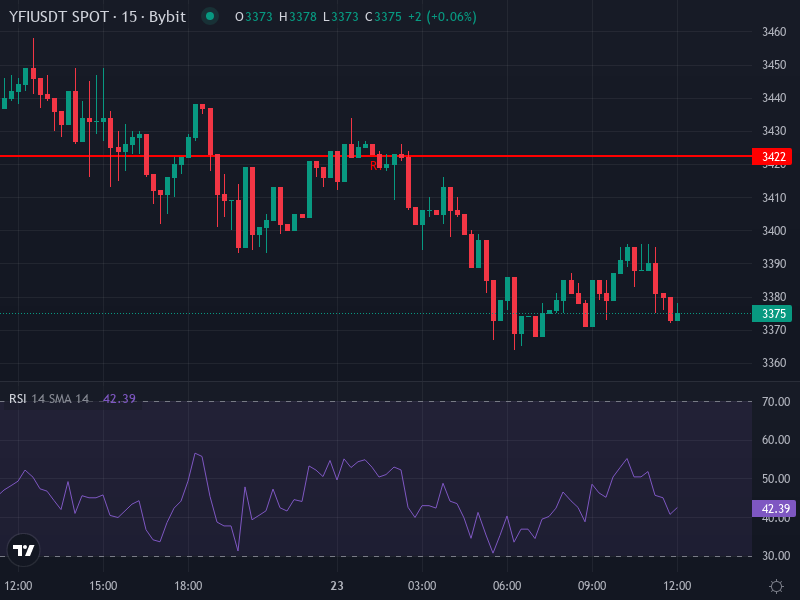
Most short-term models are pointing to YFI trading in a fairly tight range between $3,350 and $3,400 assuming no major catalyst emerges. If we make it to the end of December without another disaster, modest gains of 1-3% seem reasonable if bulls can push through that $3,420 pivot.
Longer-term recovery toward $4,000 and beyond probably requires a few things to line up: DeFi yields need to become attractive again, TVL needs to start flowing back in, and the stYFI implementation needs to prove it actually works as advertised.
Here’s what traders should keep an eye on over the coming weeks:
First, watch how the stYFI rollout actually goes. Are former veYFI holders rotating smoothly, or are we seeing selling pressure as people bail? Second, any whisper of another security issue—even a small one—could crater the price given current sentiment. Third, macro matters more than usual right now. Policy shifts, regulatory news, or changes in overall risk appetite can move altcoins dramatically regardless of what the protocol itself is doing.
And finally, pay attention to volume. If YFI tries to break resistance on weak volume, it’s probably a fake-out. Real breakouts in this environment need conviction behind them.
The Bottom Line
Yearn.finance isn’t dead, but it’s definitely not thriving either. The path forward is narrow and depends heavily on the team avoiding further missteps while executing on governance reforms. For active traders, there’s probably some opportunity in range-trading between $3,300 and $3,450, but any sustained uptrend requires both internal stability and broader market cooperation.
If you’re holding YFI, the honest truth is you’re betting on execution and a DeFi revival. If you’re thinking about entering, understand that breaking below $3,300 could open the door to significantly lower prices. This isn’t a high-conviction setup in either direction right now—it’s a wait-and-see situation where timing, volume, and trust matter more than lofty price targets.